
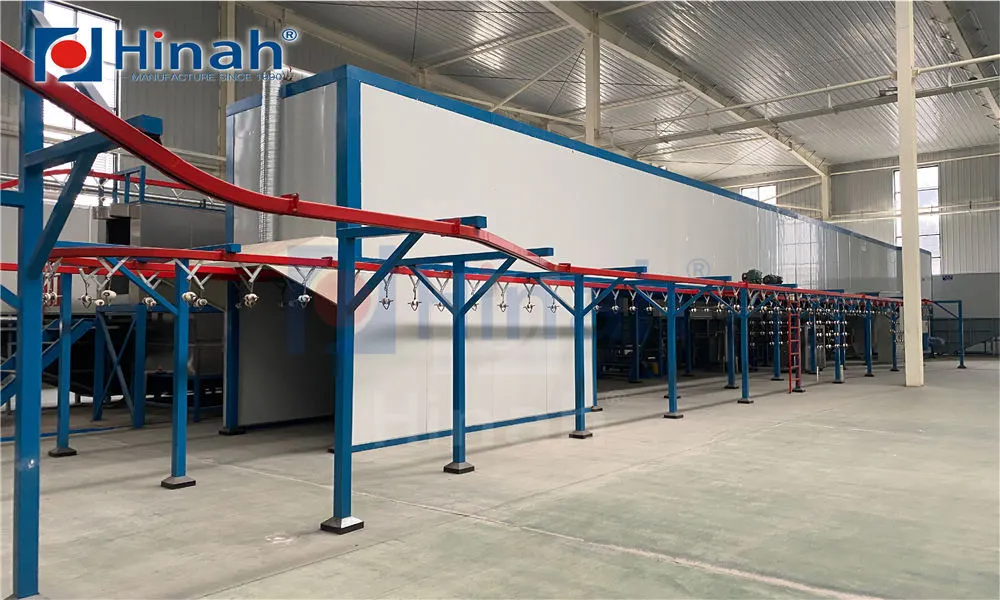
Industrial surface finishing demands precision, consistency, and strict cost control. Traditional manual coating techniques struggle to meet rising production volumes and strict environmental regulations.
Integrating an Automatic paint robot into your finishing workshop solves these operational hurdles. Robotic automation provides exact film control, lowers paint consumption, and increases daily output.
Engineering firms like HANNA supply advanced robotic finishing equipment designed to handle demanding manufacturing tasks. Pairing robotic manipulators with a modern Automatic powder coating line delivers predictable quality across complex workpieces.
Manual spray operators inevitably face fatigue during long shifts. This fatigue leads to inconsistent gun distances, erratic travel speeds, and varying dry film thickness (DFT).
An automatic painting manipulator maintains exact spray paths, consistent trigger timing, and steady atomization pressures. Every part receives the exact coating volume specified by your quality control standards.
Robotic arms follow predefined toolpaths with repeatability down to fractions of a millimeter. This consistency prevents common surface defects such as:
Runs, sags, and drips caused by over-application.
Orange peel textures resulting from unstable gun-to-part distances.
Thin spots and bare metal exposure on complex edges.
Inconsistent gloss levels across large surface areas.
When combined with electrostatic bell applicators or spray guns, robots optimize the electrostatic charge. The programmed motion ensures maximum wraparound on tubular frames, brackets, and automotive stampings.
Coating materials represent a major recurring expense in industrial finishing plants. Manual spraying often wastes up to 30% to 50% of liquid paint or powder coating due to overspray and poor transfer efficiency.
A robotic paint applicator controls spray parameters dynamically. Fluid flow rates, atomizing air, and fan pattern widths adjust instantly based on the geometry of the target surface.
Key material-saving mechanisms include:
Precise gun trigger control that shuts off fluid instantly between parts.
Controlled travel speeds that eliminate double-coating on overlapping areas.
Tight spray pattern containment that minimizes booth wall contamination.
Accurate dosing pumps that deliver exact volumes without excess purge waste.
These precise controls drastically lower raw material consumption, allowing high-volume factories to recover their capital investment quickly.
Modern production facilities run high-mix, high-volume production schedules. Achieving maximum throughput requires synchronizing robotic stations directly with an Automatic powder coating line.
Specialized manufacturers such as HANNA engineer complete finishing lines where robotics, pre-treatment wash systems, dry-off ovens, and curing tunnels share real-time production data.
Modern paint robots feature line-tracking encoders connected to overhead conveyor systems. Even if the conveyor speed fluctuates slightly, the robot adjusts its trajectory dynamically.
This tracking prevents conveyor stops, ensuring continuous coating operations without rack collisions or skipped components.
When integrated into an Automatic powder coating line, robotic cells interface directly with fast-clean powder centers. Color change cycles drop from hours to mere minutes.
Robots purge spray lines automatically using high-pressure air bursts.
Automated injectors switch supply hoppers without operator contact.
Internal spray booth walls are cleaned rapidly by programmable sweepers.
Finishing environments involve hazardous chemicals, volatile organic compounds (VOCs), and airborne combustible dust. Keeping human operators inside manual spray booths creates ongoing health and safety risks.
Deploying an Automatic paint robot isolates dangerous processes inside enclosed, negative-pressure spray booths. Operators can manage the entire finishing operation safely from an external control console.
Industrial painting robots are engineered specifically for Class 1, Division 1 hazardous environments. Features include:
Pressurized purge cavities that prevent flammable solvent vapors from reaching internal electronics.
Conductive carbon-fiber arms that dissipate static electricity buildup.
Non-sparking mechanical joints and sealed cable conduits.
Because human operators do not work directly in the spray zone, booth airflow parameters can be optimized strictly for transfer efficiency and overspray capture. This lowers the energy required for makeup air handling, filtration, and booth climate control.
Manual coating creates production bottlenecks due to required breaks, shift handovers, and physical limitations on heavy assemblies. In contrast, robotic cells operate continuously across multi-shift production schedules.
A multi-axis paint robot moves at speeds up to 2 meters per second, coating complex contours significantly faster than human operators without sacrificing film quality.
Throughput advantages include:
24/7 continuous operation with predictable production outputs.
Balanced line cycles that prevent bottlenecks ahead of curing ovens.
Dual-robot configurations capable of painting both sides of wide panels simultaneously.
Minimized rework rates, eliminating secondary sanding, stripping, and recoating.
Connecting robotic workstations inside an Automatic powder coating line gives production planners exact data on line speed, paint usage, and unit throughput per shift.
Industrial components feature intricate contours, deep recesses, cutouts, and interior cavities. Earlier automation systems like reciprocating spray machines could only coat flat, uniform profiles.
Modern six-axis and seven-axis articulated robots provide the kinematic range needed to coat complex parts cleanly and thoroughly.
Advanced finishing lines incorporate laser profile scanners or optical cameras at the spray booth entrance. As parts move along the conveyor, the vision system scans each geometry.
The system identifies the part model, checks hanging orientation, and loads the corresponding robotic spray program instantly, without manual input.
Modern offline programming software allows production teams to create, test, and optimize spray paths on a computer workstation. This process eliminates machine downtime:
CAD models of parts are imported directly into the coating simulation tool.
Spray patterns, overlap percentages, and film build are verified virtually.
Collision detection algorithms verify safe toolpath clearances.
Tested routines transfer straight to the robot controller on the shop floor.
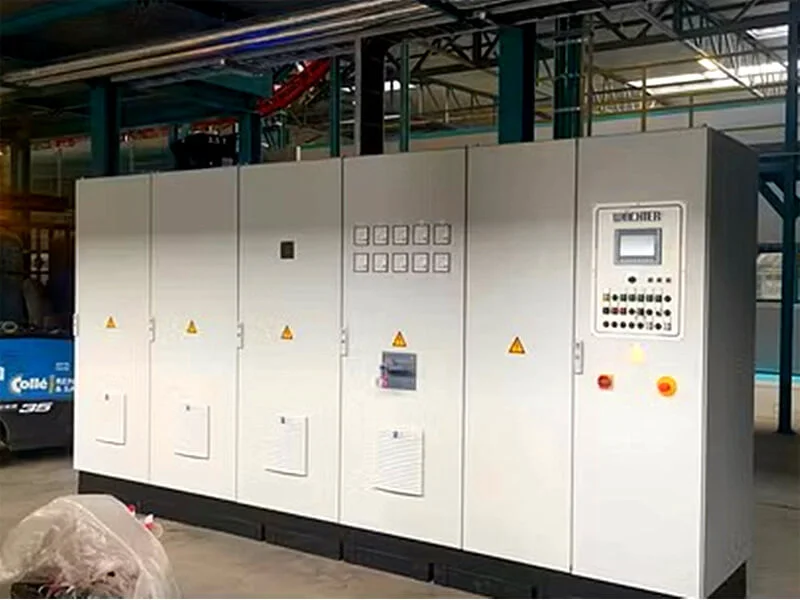
While installing robotic automation requires upfront capital expenditure, the total cost of ownership (TCO) drops dramatically over the equipment lifecycle. The primary drivers include reduced labor overhead, lower reject rates, and minimal paint waste.
Engineering teams at HANNA focus on long-term durability by building painting manipulators with high-grade components, heavy-duty gearboxes, and low-wear seals.
The financial returns of an automated installation stem from several predictable areas:
Lowering paint and powder purchases by 15% to 30% annually.
Decreasing scrap rates and rework labor to near zero.
Reducing hazardous waste disposal costs from captured overspray.
Lowering health insurance, safety certification, and protective gear expenses.
Over a multi-year production cycle, these recurring operational savings quickly outweigh the initial installation and programming investments.
Choosing the correct robotic platform requires evaluating technical specifications against your plant's production targets. Key considerations include:
Payload Capacity: Ensure the wrist can support the combined weight of the bell cup, spray gun, paint hoses, and fluid valves.
Working Envelope and Reach: Confirm the robot can reach all target surfaces on the largest rack without mechanical joint limits.
Explosion Protection: Verify international explosion-proof certifications for your regional fire and safety codes.
Controller User-Friendliness: Opt for intuitive teach pendants that allow technicians to make quick on-line path adjustments.
System Compatibility: Ensure smooth communication protocols (such as Profinet, Ethernet/IP, or Modbus) with your primary Automatic powder coating line controller.
A1: Yes. The mechanical robot arm can carry either liquid spray equipment (air spray, air-assisted airless, rotary bell) or electrostatic powder coating guns. However, fluid handling systems, dosing valves, and safety interlocks must match the specific coating material used.
A2: Integration is straightforward when engineered by experienced finishing specialists. The robot controller connects directly with the conveyor encoder and main PLC via standard industrial fieldbus networks, allowing synchronized triggering based on part presence and conveyor speed.
A3: Daily maintenance includes wiping down protective robot suits, inspecting spray nozzles for buildup, and verifying seal air pressure. Monthly checks involve inspecting drive belts, lubricating harmonic gearboxes, and testing safety e-stop circuits.
A4: In a flexible Automatic powder coating line, an upstream vision system or barcode scanner reads incoming rack identities. The scanner commands the robot controller to load the matching spray program automatically before the part enters the spray envelope.
A5: Most manufacturing plants achieve full ROI within 12 to 24 months. The payback period depends heavily on shift patterns, current reject rates, labor costs, and overall coating material expenditures.