
The industrial finishing sector depends heavily on the precision of the curing process. Thermosetting powder coatings, composed of resin binders, pigments, curing agents, and additives, rely on precise thermal exposure to initiate chemical cross-linking. Unlike liquid paints that dry through solvent evaporation, powder coatings must melt, flow, gel, and polymerize at specific high temperatures. If the heat profile within the curing chamber is inconsistent, the resulting finish may fail key performance metrics, such as impact resistance, adhesion, and gloss level. Consequently, partnering with an experienced powder coating oven manufacturer is necessary to obtain equipment capable of maintaining strict thermal control.
Industrial curing chambers are complex thermal systems designed to handle diverse workpiece geometries and varying metal thicknesses. Achieving a consistent finish across all surfaces requires a detailed understanding of heat transfer physics, fluid dynamics, and structural insulation. This analysis examines the engineering principles, structural considerations, and burner configurations necessary to design a high-efficiency powder curing system.
Thermosetting powders undergo distinct phases when subjected to heat. As the temperature rises, the solid powder particles reach their glass transition temperature and melt into a viscous liquid. This liquid must flow evenly across the substrate to wet the surface and self-level. Shortly after, the curing agents react chemically with the resin matrix, initiating gelation. Once gelation occurs, the coating loses its ability to flow. The final phase is polymerization, where the molecular structure fully cross-links to form a durable, chemical-resistant barrier.
The entire sequence must occur within a specific thermal window. For example, a standard polyester powder might require a dwell time of 10 minutes at 180°C. This temperature refers to the temperature of the metal substrate itself, not merely the air inside the chamber. If the heat-up rate is too slow, the powder may gel prematurely before leveling, resulting in a texturized "orange peel" finish. Conversely, if the heat-up rate is too rapid, the surface layer may cure before the underlying air pockets escape, causing pinholes or outgassing defects, particularly on porous castings.
Convection systems utilize high-velocity heated air to transfer energy to the workpiece. This method is highly effective for complex, three-dimensional parts with recessed areas, blind holes, or varying cross-sectional thicknesses. The circulating air reaches hidden surfaces, ensuring that the entire part reaches the target temperature uniformly. The mechanical design of these ovens relies on heavy-duty centrifugal blowers and meticulously sized ductwork to manage air volume and pressure.
Infrared (IR) curing, alternatively, uses electromagnetic radiation to heat the powder and the surface of the substrate directly. Operating in medium-to-long wave spectrums, IR ovens transfer energy rapidly, heating parts within seconds rather than minutes. This rapid heat transfer makes IR ideal for flat geometries or high-speed continuous lines. However, because IR curing is a line-of-sight process, areas in shadow remain under-cured. To balance these performance dynamics, modern finishing lines often implement hybrid configurations. In these systems, an initial IR zone quickly melts and gels the powder, preventing powder blow-off, while a subsequent convection zone completes the polymerization cycle.
Industrial powder coating operations face persistent challenges that directly affect yield rates and operational safety. Understanding these challenges allows system designers to configure robust solutions during the engineering phase.
To overcome operational challenges, a professional powder coating oven manufacturer utilizes precise structural designs and computational analysis to control how thermal energy moves through the curing chamber.
The layout of the supply and return air ductwork determines the temperature profile inside the oven. High-efficiency curing chambers use a balanced airflow design, such as bottom-up or side-draft configurations. In a bottom-up system, heated air is introduced through adjustable floor ducts, rises through the densely packed workpieces, and is drawn back into the combustion chamber through return grilles located at the ceiling.
To ensure flexibility, the ductwork must feature adjustable slide dampers along its entire length. These dampers allow operators to regulate the volume of air delivered to different zones of the oven. For instance, thicker structural steel components require a higher volume of air to heat up, whereas thin-gauge sheet metal parts require lower velocities to avoid displacement. By adjusting the damper positions, operators can fine-tune the airflow to maintain a Delta T of less than ±3°C across the entire loading area.
The selection of recirculation fans is equally important. High-volume centrifugal plug fans are preferred for their ability to deliver consistent static pressure against the resistance of internal ductwork and dense product loading. These fans must be sized to achieve an air turnover rate of at least 4 to 5 times per minute, ensuring that heat is replenished as quickly as it is absorbed by the passing workpieces.
Minimizing heat loss through the oven enclosure is paramount for maintaining thermal efficiency. Curing ovens are typically constructed using prefabricated interlocking panels. These panels consist of an inner sheet of aluminized steel, which offers high heat reflection and corrosion resistance, and an outer sheet of cold-rolled steel finished with a protective coating.
The space between the inner and outer sheets is filled with high-density rockwool insulation, typically ranging from 100 mm to 150 mm in thickness, with a density of 120 kg/m³ to 150 kg/m³. To eliminate thermal bridging, the panels must feature a tongue-and-groove joint profile with thermal breaks. This structural separation prevents any direct metal-to-metal contact between the inner and outer walls. Structural support frames must be designed to remain outside the insulated envelope or be decoupled using high-temperature thermal gaskets.
Furthermore, because the inner steel lining of the oven expands significantly during heat-up (for example, a 10-meter-long steel panel can expand by several millimeters when heated from 20°C to 200°C), the internal structure must incorporate expansion joints. These joints allow the inner panels to slide relative to one another, preventing structural warping, joint separation, and air leaks over years of thermal cycling.
Depending on production volume, space availability, and part dimensions, powder coating operations require distinct equipment layouts. Below are the primary configurations designed by HANNA to meet these diverse industrial needs.
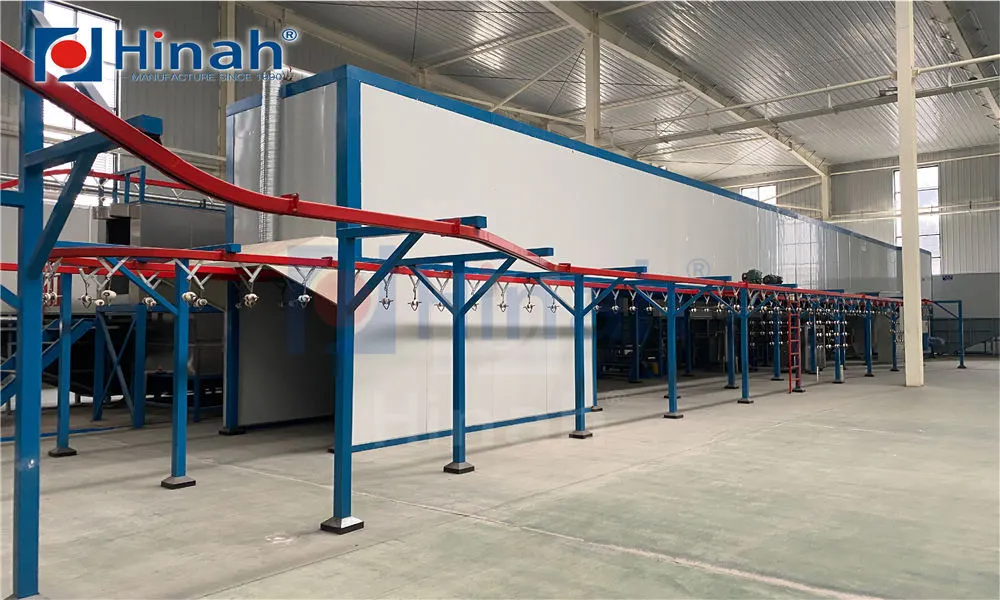
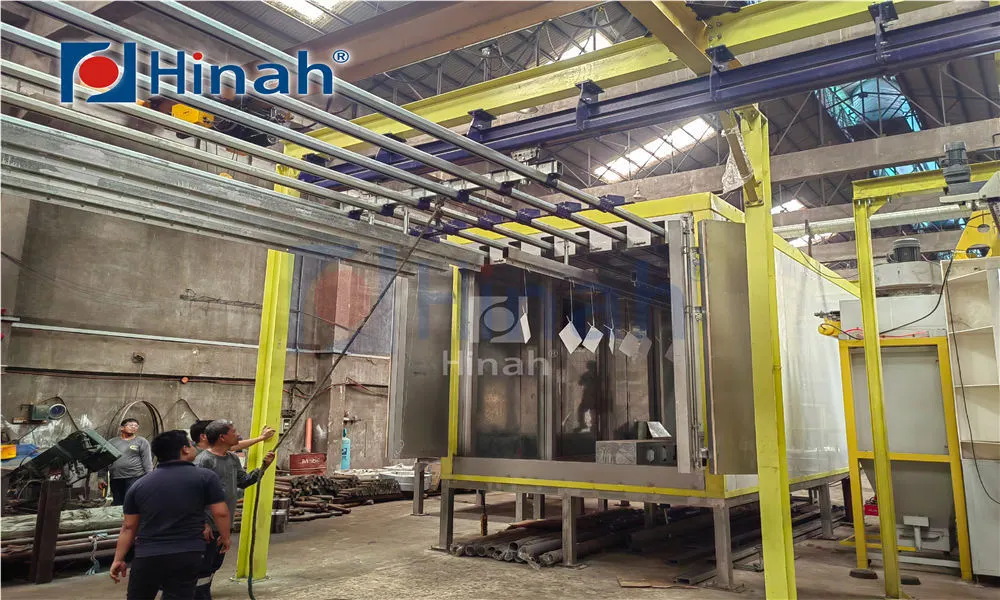
Designed for automated, high-volume production lines, continuous tunnel ovens feature open entry and exit portals through which workpieces travel on an overhead monorail or power-and-free conveyor system. Because the portals remain constantly open, containing the heated air within the chamber is a major design priority.
To prevent heat migration, tunnel ovens are configured with dynamic air curtains at both the inlet and outlet zones. These air curtains use high-velocity blowers to create a high-pressure air barrier across the opening, recirculating the air back into the oven while blocking cold factory air from entering. Additionally, tunnel ovens are often designed with an elevated center section and sloped entry/exit sections, known as an "A-frame" configuration. Because hot air naturally rises, the elevated design naturally traps the heated air within the main curing chamber, drastically reducing heat losses through the portals.
For job shops, custom coaters, or operations handling exceptionally large and heavy parts, batch ovens are the most practical solution. In a batch configuration, parts are loaded onto carts, rolled into the chamber, and the insulated doors are sealed for the duration of the curing cycle.
Batch ovens require robust door sealing systems to prevent heat escape. Pneumatically clamped doors equipped with high-temperature silicone bulb gaskets ensure a tight seal along the entire perimeter. Because heavy workpieces represent a substantial thermal mass, the burner and circulation system must be configured to deliver a high heat input during the initial ramp-up phase, rapidly driving the heavy metal parts to the required curing temperature without causing the air temperature to drop excessively.
Selecting the energy source is a primary decision when configuring a curing system. Each source has unique implications for air quality, thermal control, and infrastructure requirements.
| Energy Source | Heating Method | Air Quality Considerations | Ideal Applications | |
|---|---|---|---|---|
| Direct Gas-Fired | Burner fires directly into the recirculated air stream. | Contains combustion byproducts (NOx, water vapor). | Heavy structural steel, dark colors, high-volume industrial parts. | High thermal efficiency and fast temperature recovery. |
| Indirect Gas-Fired | Combustion occurs inside a stainless steel heat exchanger. | Completely clean air inside the curing chamber. | White coatings, high-gloss finishes, clear coats. | Eliminates yellowing risks by isolating combustion gases. |
| Electric Resistance | Electric heating elements warm the passing air. | Zero combustion byproducts, clean operation. | Cleanrooms, small batch ovens, precise laboratory testing. | Precise temperature control, low maintenance, zero local emissions. |
Direct gas-fired burners offer rapid thermal response and high efficiency, making them the standard choice for most industrial finishing lines. However, for high-performance applications where color consistency is critical, indirect-fired systems are preferred. These systems utilize a multi-pass heat exchanger constructed from high-grade stainless steel (such as AISI 310 or 321). The combustion gases pass through the interior of the heat exchanger tubes and are vented outside the facility, while the clean recirculation air passes over the exterior of the hot tubes to absorb heat. This design prevents any contamination of the curing chamber air, ensuring pristine white finishes and high-gloss clear coats.
A successful curing system must operate in harmony with the transport mechanisms and control architectures of the wider finishing line. Working with an expert powder coating oven manufacturer helps ensure that these subsystems are fully coordinated.
The conveyor speed must be carefully calculated and controlled to match the required curing cycle. If the conveyor moves too slowly, parts spend excessive time in the oven, leading to over-curing and wasted energy. If it moves too quickly, the parts leave the oven before completing their dwell time. Modern systems link the conveyor drive control with the oven's temperature controller. If a line stoppage occurs, the control system automatically throttles the burners down or opens exhaust dampers to drop the internal temperature rapidly, protecting the static parts inside from thermal damage.
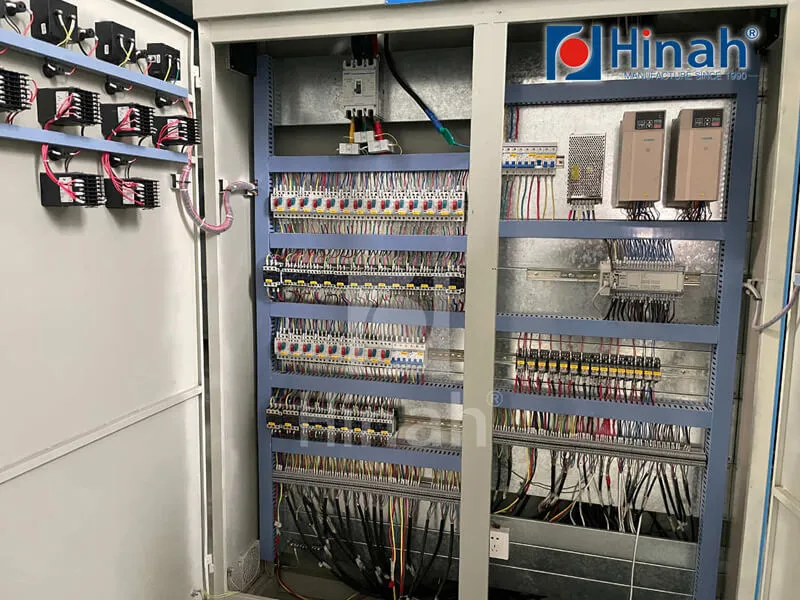
Advanced control units utilize PLC (Programmable Logic Controller) systems integrated with color touch-screen HMI (Human-Machine Interface) panels. These systems store multiple curing profiles tailored to different part configurations, metal thicknesses, and powder chemistries. The PLC monitors real-time feedback from multiple thermocouples distributed throughout the oven chamber, modulating the burner output via proportional-integral-derivative (PID) control loops to maintain stable temperatures.
Furthermore, integrating with systems designed by HANNA for multi-stage processing allows for automated start-up timers and exhaust fan modulation. Variable frequency drives (VFDs) on the exhaust fans can adjust the exhaust rate based on the current paint volume, minimizing heat loss while maintaining safe solvent and VOC dilution levels within the chamber.
To verify that the curing system is performing to specification, regular thermal profiling must be conducted. This procedure involves attaching a temperature data logger to a representative test part. Thermocouple probes are placed at various locations on the part, including thick and thin cross-sections, to record the exact metal temperatures as the part moves through the curing oven.
The resulting profile graph plots temperature against time, showing the exact moment the metal reaches the target temperature and how long it remains there. This profile must fall entirely within the powder manufacturer's cure window specification. If the graph reveals that thicker sections of the part fail to reach the required temperature, adjustments must be made to the oven's zone setpoints, conveyor speed, or air distribution duct dampers. A reliable finishing line configuration provides dedicated access ports and profiling support to simplify this ongoing validation process, ensuring consistent quality day after day.
Every powder coating application presents unique requirements based on production volume, space constraints, and the physical characteristics of the parts being coated. Off-the-shelf heating equipment rarely meets the precise demands of a high-capacity industrial finishing line. Achieving high transfer efficiency, minimizing rejects, and maintaining low energy consumption requires a custom-engineered solution tailored to your specific process flow.
By defining your target workpiece dimensions, maximum weights, daily production goals, and available energy resources, you can begin the design process with a clear set of engineering parameters. To receive a detailed system layout, thermal analysis, and equipment proposal customized for your facility, please reach out to the engineering team at HANNA to submit your specific project inquiry.
Q1: What is the typical temperature range required for industrial powder curing?
A1: Standard thermosetting powder coatings typically require a metal substrate temperature between 160°C and 200°C (320°F to 400°F). Low-cure powder chemistries can cure at temperatures as low as 130°C to 150°C, while some specialty functional coatings may require temperatures up to 220°C.
Q2: Why is selecting a qualified powder coating oven manufacturer important for production quality?
A2: An experienced manufacturer understands how to design balanced airflow ducts, choose high-density insulation materials, and implement precise thermal expansion joint designs. This engineering expertise ensures temperature uniformity across the entire curing chamber, preventing under-curing, over-curing, and surface contamination defects.
Q3: How does an indirect gas-fired system prevent powder discoloration?
A3: An indirect gas-fired system uses a stainless steel heat exchanger to keep combustion products, such as nitrous oxides, isolated from the air inside the curing chamber. Because these combustion byproducts never contact the curing workpieces, the risk of chemical yellowing—especially on white or clear coatings—is eliminated.
Q4: What is thermal bridging and how can it be avoided in oven construction?
A4: Thermal bridging occurs when a metal component conducts heat directly from the inner liner of the oven to the outer casing. To prevent this, manufacturers design structural panel joints with built-in thermal breaks, using high-temperature insulating gaskets to isolate the inner and outer metal surfaces.
Q5: What is the purpose of run-in and run-out vestibules in tunnel ovens?
A5: Vestibules are unheated extension zones located at the entrance and exit of a continuous tunnel oven. These sections help capture escaping hot air and contain it using localized exhausts or air curtains, preventing heat from radiating directly into the plant floor and improving the overall thermal stability of the oven.