
Whether for powder coating, liquid paint, or e‑coat, the coating oven is where the applied film transforms into a durable, protective layer. A well‑designed oven ensures uniform crosslinking, optimal appearance, and long‑term performance. This article provides a comprehensive technical overview of industrial coating ovens, covering heat transfer principles, equipment types, process control, and how leading suppliers like HANNA engineer systems that deliver consistent results while minimizing energy costs.
Effective curing relies on transferring sufficient thermal energy to the coated substrate. Three modes dominate:
Convection – Heated air circulates around parts, transferring heat through boundary layers. High‑velocity air (10–30 m/s) disrupts stagnant air, accelerating warm‑up. Convection is versatile for complex geometries and is the most common method in batch and continuous ovens.
Infrared (IR) – Electromagnetic waves directly heat the coating and substrate without needing air as an intermediate. IR is rapid and efficient for flat or simple shapes, often used as a booster to quickly gel powder coatings.
Combination (IR + convection) – Many modern coating oven designs integrate IR at the entrance to rapidly raise part temperature, followed by convection zones to complete crosslinking evenly. This hybrid approach can shorten oven length by 30–40 %.
The choice of oven depends on production volume, part size, and coating chemistry.
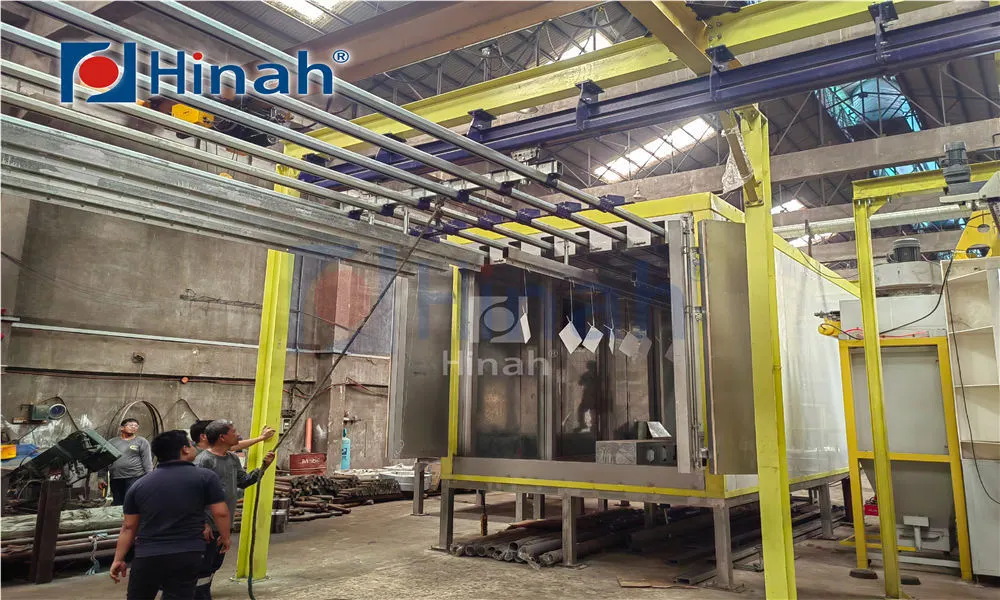
Ideal for job shops and low‑volume production, batch ovens process discrete loads on racks or carts. They offer flexibility for varied part sizes and quick colour changes. Modern batch ovens feature high‑efficiency insulation, digital controls, and optional atmosphere sealing for sensitive coatings. HANNA supplies custom‑built batch ovens with validated temperature uniformity (±2 °C) for applications from aerospace components to heavy machinery.
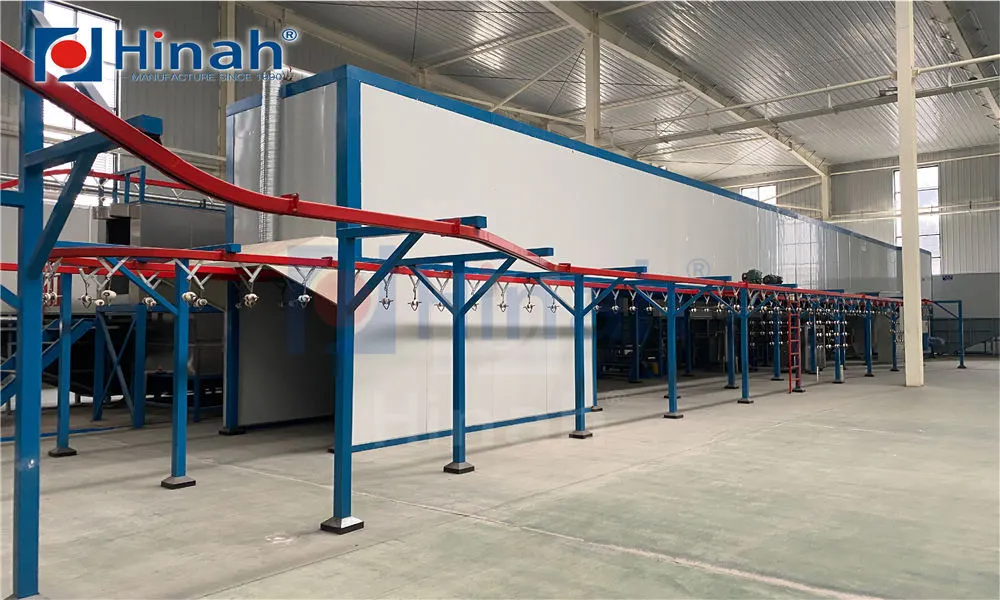
For high‑volume lines, parts move through a tunnel‑style oven on an overhead or floor conveyor. Continuous ovens maintain steady‑state temperatures, enabling consistent throughput. They are essential for automotive bodies, architectural extrusions, and appliance panels. Multi‑zone designs allow precise temperature profiling along the part’s path. Coating oven systems from HANNA incorporate CFD‑optimised ductwork to ensure uniform airflow across the product width.
IR ovens use medium‑ or short‑wave emitters to directly heat surfaces. They are compact and energy‑efficient for flat stock or pre‑heated parts. Often integrated into multi‑stage lines, IR zones quickly set powder coatings to prevent contamination before convection curing.
These integrate IR and convection in one enclosure. The IR section rapidly raises part temperature, while downstream convection zones provide thorough heat penetration. Hybrid designs are particularly effective for heavy parts or when floor space is limited.
Engineering a high‑performance oven involves several critical factors.
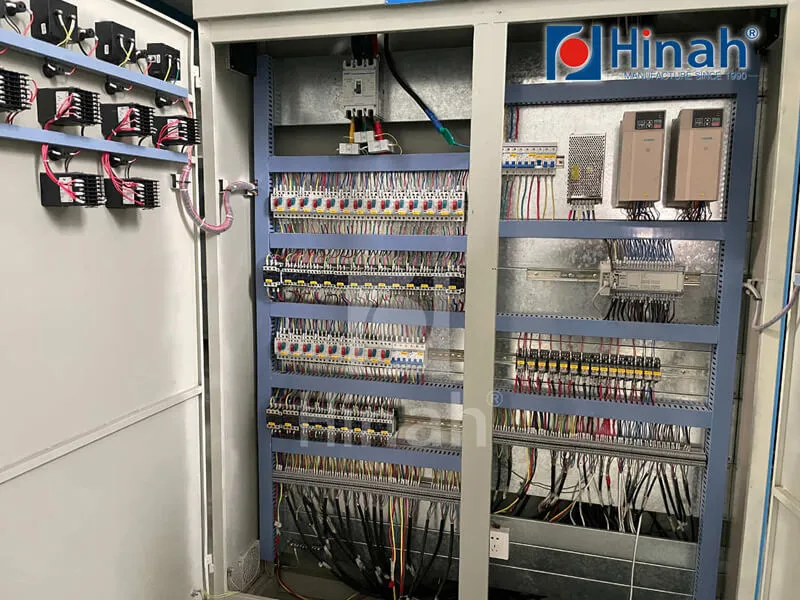
ISO 13924 and similar standards require that air temperature across the working zone be within ±3 °C of setpoint. Non‑uniformity leads to under‑cured spots (poor adhesion) or over‑cured areas (discoloration, brittleness). Achieving uniformity demands balanced duct design, multiple control zones, and precise PID algorithms. HANNA validates every oven with temperature distribution tests using 20+ thermocouples.
Natural gas is the most common heat source due to low operating cost, but electric, thermal oil, or steam are used in specific situations. Energy efficiency measures include:
High‑density insulation (100–200 mm mineral wool) to reduce shell losses.
Variable frequency drives (VFDs) on recirculation fans to match airflow to load.
Heat recovery from exhaust (e.g., recuperators to preheat combustion air or incoming parts).
Air seals or vestibules at conveyor openings to minimise infiltration.
Modern ovens from HANNA incorporate these features, often achieving 20–35 % lower energy consumption than conventional designs.
In liquid paint lines, oven air must be particle‑free to avoid dirt inclusion. High‑efficiency filters (e.g., MERV‑14 or better) are used. For powder coating, slight negative pressure prevents dust escape. Air distribution via slotted nozzles or perforated plates ensures uniform impingement.
The oven must seamlessly interface with the conveyor system. Supports must withstand high temperatures without warping, and bearings require high‑temperature lubrication. HANNA designs conveyor‑compatible ovens with minimal thermal expansion interference.
Even well‑engineered ovens can encounter issues. Below are common problems and how to resolve them.
Complex shapes can create air‑flow shadows, leading to cooler zones. Solutions include adjustable nozzles, “air rotation” systems that periodically reverse airflow direction, and CFD‑optimised duct layouts. Coating oven designs from HANNA are tailored to the specific product mix to minimise shadows.
Volatiles released during curing can condense on cooler oven walls or parts, causing defects. Adequate exhaust (maintaining slight negative pressure) and regular cleaning are essential. Some ovens incorporate catalytic oxidisers to destroy VOCs while recovering heat.
Drift in temperature or dwell time leads to quality issues. Real‑time monitoring with travelling thermocouples and data loggers provides verification. Statistical process control (SPC) software alerts operators before non‑conforming parts are produced.
Gaps around conveyor entries and exits waste heat. Air seals, double doors (for batch ovens), or labyrinth seals minimise losses. Regular inspection and maintenance of seals are recommended.
When investing in a new oven, engineers must evaluate:
Production rate and part mix – Determines oven type (batch vs. continuous) and dimensions.
Cure schedule – Required temperature and dwell time for the specific coating (e.g., powder, liquid, e‑coat).
Part mass and material – Heavy parts require higher heat input and longer dwell.
Available floor space – Multi‑pass or hybrid designs can fit limited footprints.
Energy source and cost – Gas, electric, or alternative fuels.
Regulatory compliance – Emissions limits, safety standards (NFPA, EN 746).
HANNA provides detailed engineering studies, including heat load calculations and ROI analyses, to help clients select the optimal coating oven for their needs.
Coating oven technology is used across virtually every manufacturing sector:
Automotive – Curing e‑coat, primer, and topcoat on car bodies, wheels, and components.
Architectural aluminium – Extrusions for windows, curtain walls, and cladding are powder coated and cured in long continuous ovens.
Appliances – Refrigerator panels, washing machine drums, and HVAC cabinets.
General industrial – Agricultural machinery, electrical enclosures, furniture, and thousands of fabricated metal parts.
Aerospace – High‑performance primers and topcoats require precise cure cycles, often in batch ovens with data logging.
Coil coating – Continuous steel or aluminium strips are cured in flotation ovens at high speeds.
Q1: What is the difference between a curing oven and a drying oven?
A1: A drying oven removes solvents or water at relatively low temperatures (<100>coating oven (curing oven) operates at higher temperatures (typically 150–230 °C) to initiate polymerisation or crosslinking in powder coatings and thermoset liquid paints.
Q2: How do I determine the required oven temperature and time for my coating?
A2: Always follow the coating manufacturer’s technical data sheet (TDS), which specifies the substrate metal temperature needed. Because heavy parts heat slowly, you must measure actual part temperature with data loggers, not just air temperature, to verify that every part reaches the specified conditions for the required duration.
Q3: Can I use the same oven for powder coating and liquid paint?
A3: Yes, if the oven can achieve the temperatures required for both (powder typically 160–200 °C, liquid may be lower) and has adequate exhaust to handle solvent vapours. However, cross‑contamination risk exists, so dedicated ovens are often preferred for high‑quality work.
Q4: What is typical energy consumption of a continuous coating oven?
A4: Energy use depends on part mass, line speed, and insulation. A medium‑size oven curing 2 tonnes/hour of steel might consume 300–500 kW thermal (gas) and 50–100 kW electric for fans. Retrofitting heat recovery and VFDs can reduce consumption by 20–30 %. HANNA offers energy audits to identify savings.
Q5: How often should a coating oven be maintained?
A5: Preventive maintenance every 3–6 months: lubricate fan bearings, check belt/chain tension, clean filters and nozzles, calibrate thermocouples and controllers. Burner safety systems require annual certification. Modern ovens with predictive sensors can schedule maintenance based on actual wear.
Q6: What causes yellowing or discolouration after curing?
A6: Over‑baking (excessive time or temperature) is the most common cause. Contaminants in the oven atmosphere – such as volatiles from previous batches or incomplete combustion – can also stain surfaces. Accurate temperature control (±2 °C) and proper exhaust prevent this.
Q7: Can an existing batch oven be converted to continuous operation?
A7: In some cases, batch ovens can be modified by adding a conveyor and zoning, but the cost often approaches that of a new continuous oven. HANNA evaluates each facility’s layout and production goals to recommend the most economical solution, whether a retrofit or a new oven.