
In high-volume coating operations, a powder coating line is not merely a series of machines—it is a precisely balanced thermodynamic and electrostatic system. Variations in part geometry, substrate condition, or cure dwell time directly translate into orange peel, poor adhesion, or reject rates exceeding 8%. This guide dissects the engineering levers that determine coating quality, uptime, and profitability. Drawing from HANNA’s field deployments across automotive, architectural extrusion, and heavy equipment sectors, we examine actionable solutions for the industry's most persistent technical failures.
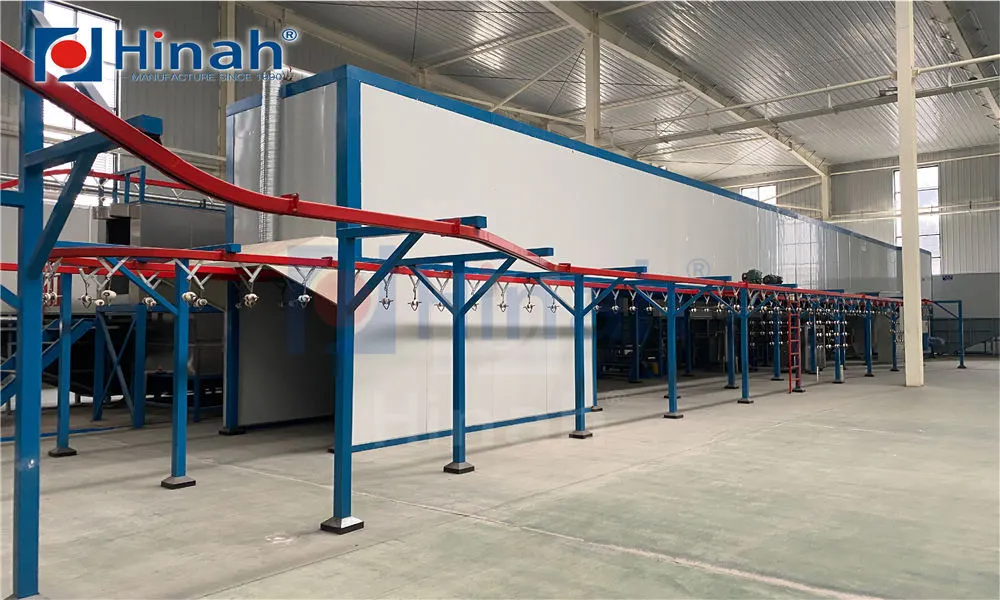
Every powder coating line integrates five interdependent stations: cleaning/pretreatment, drying, electrostatic application, curing oven, and material handling (conveyor + powder recovery). Weakness in any single module forces downstream defects. Modern integrators like HANNA emphasize closed-loop feedback between oven profiling and conveyor speed modulation.
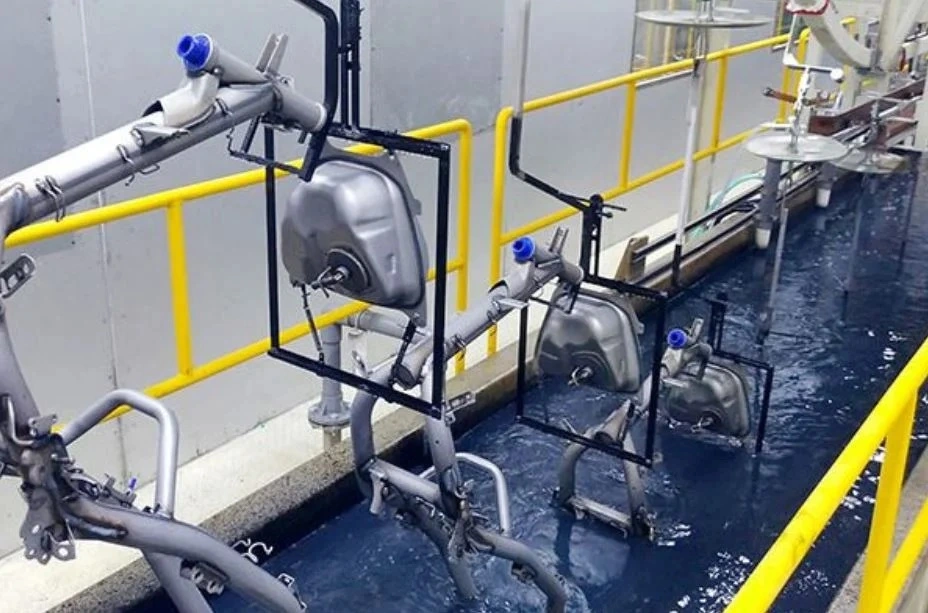
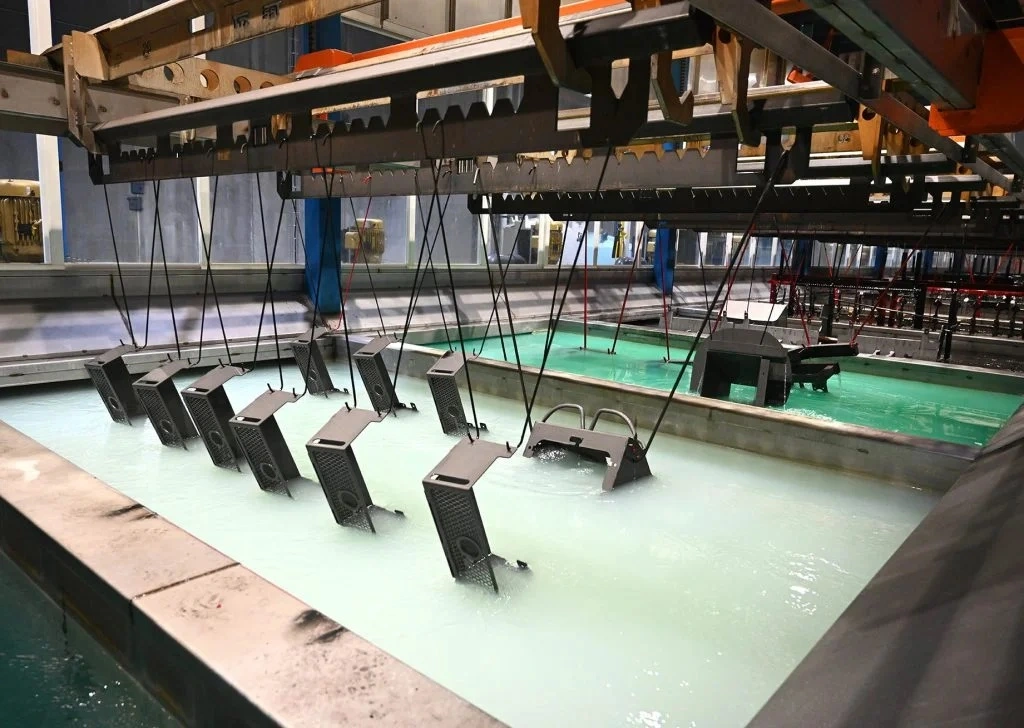
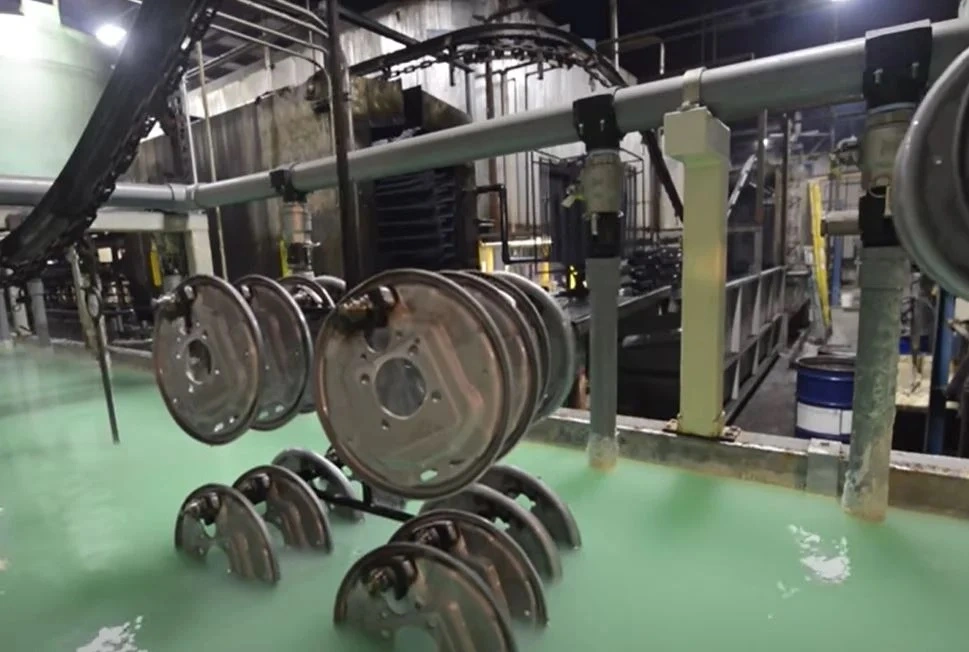
Pretreatment zone: Multi-stage spray or immersion – degreasing, rinsing, and conversion coating (zinc phosphate or nano-ceramic).
Drying oven: Removes residual moisture; must achieve substrate delta T below 5°C before coating.
Application booth: Corona or tribo guns, powder feed center, cyclone + cartridge filter recovery.
Curing oven: Gas-fired or IR/convection hybrid; precise thermal profiling for resin crosslinking.
Overhead monorail or power-and-free conveyor: Controls line speed and part orientation.
When designing a new powder coating plant, engineers must simulate thermal mass variability—solid steel parts vs. aluminum extrusions demand different heat-up rates. Neglecting this leads to under-cured thick sections and over-cured thin walls (color shift, brittleness).
Different industries impose distinct constraints on a powder coating line. Automotive wheels require high-impact resistance (ASTM D2794 >160 in-lb) and 1000h salt spray tolerance. Agricultural implements need UV-stable polyester powders that survive abrasion from soil and chemicals. Architectural profiles mandate AAMA 2604 compliance—chalking resistance and color retention after 10 years. Below are tailored configurations:
Automotive & e-mobility: Fast color change (<12 min), low-temperature cure (160°C for battery housings), and Faraday cage coverage on complex castings.
Home appliances (refrigerators, ovens): High line speeds (6-8 m/min), smooth thin films (60-80 µm), and zero silicone contamination to avoid cratering.
Building & construction (aluminum profiles): Horizontal or vertical powder coating line with super-chromatic pigments; cure oven uniformity ±3°C across 6 m length.
Heavy machinery: Thick-film capability (120-200 µm) for corrosion protection; shot-blast pretreatment to remove mill scale.
A powder coating plant serving mixed production must incorporate modular booths (e.g., movable walls) and automated gun movers to adjust to varying part widths without interrupting flow. HANNA has deployed such hybrid lines where quick-color-change zones reduce downtime from 45 minutes to under 8 minutes, a critical factor for job shops running 20+ color changes per shift.
Defect mapping reveals that over 70% of coating rejects originate from three sources: inadequate pretreatment, incorrect cure schedule, or electrostatic wrap deficiency. Below we dissect each failure mechanism with quantifiable remedies.
Root cause: Incomplete degreasing or conversion coating layer too thin (<0.2 g/m² phosphate crystal). Solution: Implement online conductivity and pH monitoring in rinse stages. For aluminum, switch to titanium-zirconium (TiZr) nano-coating which offers better edge coverage and eliminates heavy metal sludge. Retrofit a powder coating line with automated chemical replenishment dosing pumps, maintaining bath concentration within ±3%.
Root cause: Powder viscosity too high or curing temperature ramp too steep (gelation before complete flow). Solution: Use rheology-modified tribo-friendly powders; adjust oven zone 1 temperature down by 15°C to allow a 60-second flow phase before crosslinking. Infrared thermal imaging of parts entering the oven ensures the substrate reaches gel point (approx 120°C for epoxy-polyester hybrids) uniformly.
Root cause: Corona guns with excessive free ions; part geometry creating a “cage” effect. Solution: Integrate tribo guns (friction charging) in critical zones or use dual-voltage corona guns (30-50 kV). Adjust gun positioning robots to oscillate with a 150 mm standoff distance. Many modern powder coating plants combine multi-gun arrays with 3D part scanning to pre-program voltage and air flow patterns for complex castings.
Root cause: Fluctuating powder output from pump (venturi effect instability) or conveyor bounce. Solution: Install mass flow control with closed-loop feedback; dense-phase pumps (HDLV) reduce air volume and improve transfer efficiency by 18-25%. Additionally, magnetic conveyor chain guides eliminate vertical play during booth passage.
Root cause: Over-cure due to temperature overshoot or extended dwell. Solution: Retrofit oven with a dual-zone gas burner and proportional-integral-derivative (PID) control, plus thermocouples attached to representative sample parts. For MDF or assembled components, switch to low-temperature cure powders (130°C x 15 min). HANNA offers a retrofit package that upgrades legacy ovens with high-velocity air impingement nozzles, reducing cure time by 30% while eliminating hot spots.
In a typical powder coating line, overspray accounts for 35-50% of consumed powder. Without a high-efficiency recovery circuit, material costs spiral and booth downtime increases. Modern cyclone + cartridge filter combinations achieve 98% reclaim efficiency when correctly sized for particle size distribution (D50: 30-45 µm). Key engineering considerations:
Cyclone cut point: A 4-inch cyclone removes particles > 10 µm; finer particles (<5 µm) are vented to secondary filters to prevent contamination of reclaimed powder with “fines” (which degrade fluidity).
Sieving station: Vibratory or centrifugal screens (120-150 mesh) remove agglomerates and foreign debris before powder is recirculated.
Ratio control: Automatic blending of reclaim-to-fresh powder at 25/75 ratio to maintain consistent chargeability and flow.
Data from HANNA installations shows that optimizing the recovery system in a powder coating plant reduces virgin powder consumption by 27%, lowering per-part cost by $0.18–$0.32 for medium-sized batches. Moreover, a consistent reclaim ratio stabilizes film thickness variation within ±6 µm.
Curing ovens represent the largest energy consumer in any powder coating line—often exceeding 60% of total electricity and gas usage. Cutting-edge lines employ three strategies:
Catalytic infrared (CIR) boosters: Pre-heat parts from 20°C to 100°C in 40 seconds before entering convection zone, reducing gas consumption by 18%.
Exhaust heat recovery: Recirculate oven stack gases (still at 180-220°C) to the pretreatment dryer using cross-flow heat exchangers.
Zone-specific insulation: 150 mm mineral wool panels on oven walls, plus automated sealing curtains at part entries/exits to prevent infiltration losses.
Additionally, advanced cure monitoring using “smart” part tags (RFID + thermochromic indicators) allows real-time adjustment of line speed. If a thick-walled casting exits the oven with under-cured surface (measured via infrared pyrometer), the control system automatically reduces conveyor speed for the next 5 minutes. This adaptive approach secures full crosslinking without over-curing smaller parts.
Unplanned downtime on a high-volume powder coating line costs $2,000–$8,000 per hour depending on industry. A predictive maintenance (PdM) regimen integrates vibration analysis on fan bearings, weekly powder hose abrasion checks, and monthly gun tip voltage verification. The most frequent failure points:
Conveyor chain elongation: Measure every 500 operating hours; replace links at 3% stretch to avoid part swaying.
Cartridge filter blinding: Monitor differential pressure across filters (set alarm at 1.2 kPa). Implement pulse-jet cleaning with dry nitrogen for explosive atmospheres.
Burner nozzle coking: For gas-fired ovens, quarterly borescope inspection; clean using compressed air and chemical descalant.
HANNA’s remote diagnostics platform for powder coating line customers provides real-time alerts on these parameters via IoT gateways. Since 2022, early adoption has reduced emergency interventions by 63% across monitored plants.
Choosing the right partner for a new or retrofitted powder coating line requires more than comparing price lists. Request evidence of:
Thermal simulation capability: Can they model oven heat-up curves for your specific part mix using CFD software?
Color change demonstration: What is the documented average changeover time for dark-to-light colors?
Spare parts availability: Lead times for critical items like gun needles, pump membranes, and oven thermocouples.
HANNA maintains a global stock of over 2,800 line-specific components and provides 24/7 remote troubleshooting. Their engineering team publishes line performance guarantees—including transfer efficiency (min 65% for mixed shapes) and first-pass yield (>94%). This transparency aligns with E-E-A-T principles, offering buyers verifiable metrics rather than marketing claims.
The next-generation powder coating plant will rely on digital twins—virtual replicas that simulate every booth, oven zone, and conveyor segment. Operators can run “what-if” scenarios: adjusting gun voltage or line speed to predict film build and appearance. Early adopters report 22% faster color change setup and 17% reduction in scrap during new part introductions. Concurrently, binder chemistry evolution is enabling powders that cure at 120–140°C, opening applications on heat-sensitive assemblies (electronic enclosures, polymer composites).
Furthermore, AI-powered vision systems now detect pinholes, craters, and orange peel in-line at 0.2 mm resolution, feeding back to electrostatic parameters in milliseconds. Integrating such systems into an existing powder coating line can be achieved via retrofit add-ons without stopping production.
Q1: What is the typical line speed range for an automotive powder coating line?
A1: For automotive wheels and trim components, line speeds typically run between 3.5 and 5.5 m/min, depending on part mass and oven length. Larger parts like chassis frames operate at 1.5–2.5 m/min to ensure adequate heat soak. A modern powder coating line with IR boosters can increase speed by 30% while maintaining cure specs.
Q2: How do you prevent contamination between different powder chemistries (epoxy vs. polyester)?
A2: Strict segregation requires dedicated feed hoses, blow-off nozzles, and washdown protocols. For powder coating plants handling frequent chemistry changes, install removable booth modules and use dedicated recovery containers. HANNA recommends a 3-stage purge: compressed air blow (2 min), vacuum suction (1 min), and deionized air flush (1 min) before switching polymer families.
Q3: What is the minimum investment required for a small-scale powder coating line (batch operation)?
A3: A manual batch powder coating line with a 6 ft x 6 ft x 8 ft oven, single gun booth, and basic pretreatment (pressure washer + manual spray wand) starts at $48,000–$72,000. However, semi-automatic lines with conveyor and reclaim system typically range $180,000–$350,000. For job shops, HANNA offers modular systems that scale from 2 to 12 guns.
Q4: How often should powder coating line filters be replaced?
A4: Cartridge filters in the recovery booth should be replaced every 1,200–1,500 operating hours or when pressure drop exceeds 1.2 kPa at rated airflow. Pre-filters (inlet air to oven) require monthly inspection; replace when visibly loaded. For high-pigment powders (e.g., RAL 9005 black), filter life reduces by 20% due to carbon fines.
Q5: Can a powder coating line cure powder on zinc-plated or galvanized surfaces without outgassing?
A5: Yes, but outgassing voids occur if the substrate temperature rises too quickly. The solution: preheat galvanized parts to 110°C for 5 minutes before powder application to release trapped hydrogen, then apply powder and cure using a ramped profile (start at 130°C, increase 10°C/min to 190°C). Modern powder coating line designs include a “degassing zone” prior to the coating booth, eliminating this defect entirely.
Q6: What is the acceptable limit for reclaim powder fines (particles <10 µm) in a closed-loop system?
A6: Fine content should remain below 12% of total reclaim weight. Exceeding 18% causes poor fluidization and Faraday cage issues. Use a cyclone with a 12 µm cut point and periodically bleed 5% of the fines to a waste container. Most powder coating plants now include an automated fines extraction valve triggered by real-time particle size analysis.
Q7: How does humidity affect electrostatic application in a powder coating line?
A7: Relative humidity above 70% reduces powder resistivity, lowering transfer efficiency by up to 40%. Below 30% RH, static buildup leads to “back ionization” (cratering). The optimal range is 45–55% RH. Install adiabatic humidifiers or dehumidifiers in the booth zone; HANNA’s integrated climate control module maintains ±5% RH setpoint automatically.
Need a site-specific engineering assessment for your powder coating line? Whether you are planning a greenfield facility or retrofitting an existing line to improve first-pass yield and reduce energy costs, the technical team at HANNA provides detailed heat-transfer simulations, ROI projections, and turnkey integration services.
Request your confidential consultation: Share your part dimensions, desired output (parts/hour), and current defect rate. Our engineers will return a process optimization proposal within 5 business days. Click here to submit an inquiry → (or email neil@autocoatinglines.com).
© 2026 HANNA — Precision powder coating solutions for automotive, industrial, and architectural finishing.