

Powder Coating Curing Oven: Cure Window and Oven Design Guide
A powder coating curing oven is often described as the stage where coated parts are heated, yet that description misses the process physics that determine adhesion, impact resistance, gloss consistency, and color stability. The oven must deliver heat into a three-dimensional part mix, raise the substrate to the required cure temperature, hold that temperature within the chemistry’s window, and do so without overbaking thin sections or undercuring thick sections. Because powder coatings are thermosetting systems, the cure stage is where resin, crosslinker, pigment, and filler form the final network. Share your part mix, substrate range, and line constraints with HANNA to begin an inquiry around a curing oven specification that matches your production reality.
What Defines a Powder Coating Curing Oven in Industrial Finishing?
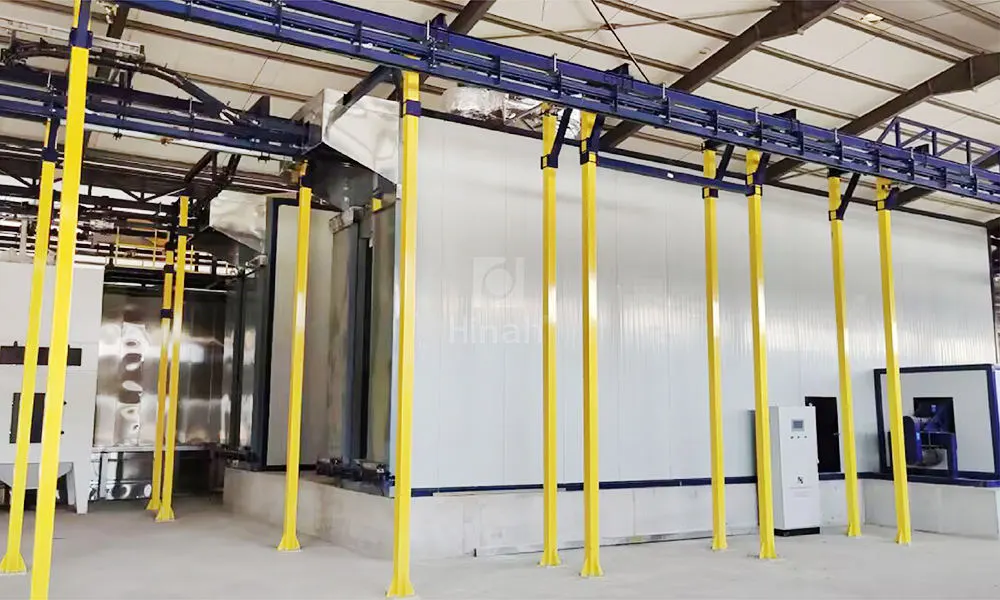
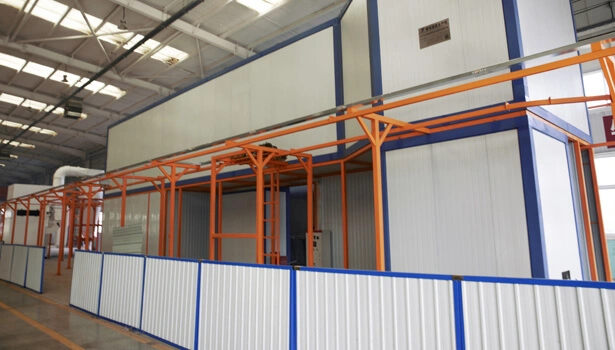
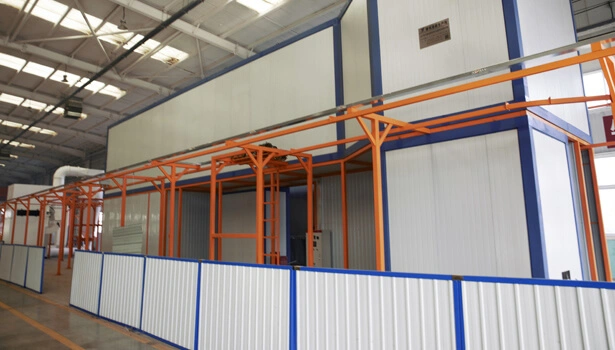
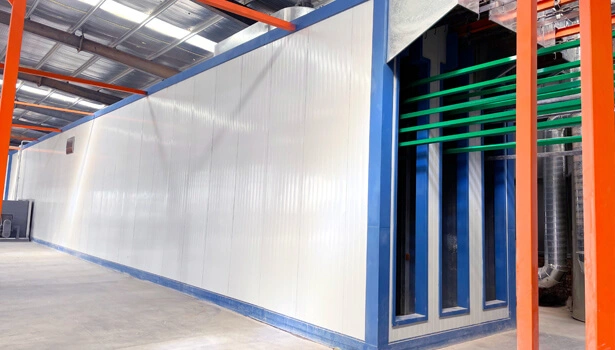
The equipment category covers batch truck ovens, walk-in chambers, conveyorized tunnels, monorail ovens, and hybrid convection-infrared systems. Each format solves a different heat-transfer problem. A batch oven suits low-volume, high-variation work where parts hang on carts and the cure cycle is managed by time-temperature profiles. A conveyorized oven suits stable part families and line speeds where dwell time is set by chain speed and zone length. The common requirement is not uniform air temperature at a sensor; it is uniform part temperature across the load, including shadowed areas, stacked surfaces, and high-mass sections that absorb heat more slowly than thin panels.
Cure Chemistry and the Heat-Transfer Problem
Polyester, epoxy, polyester-epoxy hybrid, polyurethane, and acrylic powder systems use different crosslinkers and therefore different time-temperature relationships. A TGIC polyester may cure within a defined window at a given metal temperature, while a hydroxyl-functional polyester with blocked isocyanate requires a different dwell and ramp profile. The oven controller may display air temperature, but the coating responds to substrate temperature and film thickness. Thick castings, welded assemblies, and dense racks create a thermal lag that air-temperature readings cannot reveal. The cure schedule therefore needs a heat-up phase, a dwell phase at metal temperature, and a cooling phase that protects the film from handling damage before the network fully develops.
Oven Architectures: Batch, Conveyorized, and Hybrid
- Batch truck ovens use cart-mounted loads, programmable ramp-soak profiles, and high-velocity airflow to penetrate dense part arrangements.
- Conveyorized tunnels divide heat-up, dwell, and cooling into zones, with chain speed and zone length defining the exposure time.
- Monorail ovens follow a continuous path and suit high-volume lines where part orientation and hanging density are stable.
- Hybrid convection-infrared ovens use infrared elements to accelerate surface heat-up while convection air equalizes part temperature and reaches shadowed geometry.
Architecture selection follows part geometry and production rhythm. A high-mass weldment with deep recesses needs airflow that reaches internal surfaces and a ramp rate that does not overshoot thin flanges. A flat architectural panel may tolerate faster heat-up, but color and gloss consistency still depend on uniform metal temperature across the panel face. The oven’s internal air distribution, burner modulation, and exhaust balance therefore matter as much as the setpoint.
How Cure Schedule Variables Interact with Part Geometry
Cure schedule development starts with the coating supplier’s recommended metal-temperature window, then translates that window into oven settings for the actual load. A profile that works for a 1.0 mm panel may leave a 10 mm flange below the crosslink threshold. The heat-up rate is governed by airflow velocity, air temperature, part mass, surface area, and hanging pattern. Dense loads shield each other from moving air, so the oven may satisfy its air-temperature sensor while the center of the load remains in the heat-up phase. This is why loaded-profile testing uses contact thermocouples or wireless data loggers on representative parts rather than relying on fixed air-temperature readings alone.
Airflow, Temperature Uniformity, and Heat-Up Rate
Convection heat transfer depends on air velocity across the part surface and on air circulation through the load. Supply ducts, slot nozzles, and adjustable louvers shape the flow field, while variable-frequency drives on supply fans allow the airflow to match load density. Temperature uniformity surveys map the working chamber under empty, loaded, and dynamic conditions. The survey identifies stagnant zones near door seals, roof panels, and cart corners. Data logging of both air and part temperature then shows the actual heat-up rate and dwell. For conveyorized lines, zone-to-zone temperature transitions and chain-speed stability determine whether every part receives the same exposure.
Energy and Combustion Control Without Sacrificing Cure
Energy performance follows the relationship between useful heat absorbed by the load and heat lost through exhaust, walls, and openings. Burner modulation, airtight door seals, insulated panels, and heat recovery from exhaust can reduce fuel demand, but each measure interacts with cure consistency. Excessive exhaust reduces oven temperature recovery after the load enters; insufficient exhaust allows solvent and decomposition byproducts to accumulate. Electric heating offers precise zone control for smaller tunnels, while gas-fired convection remains common for larger ovens. Infrared boost zones can shorten heat-up for thin parts, yet they require careful placement so that complex geometry does not receive uneven surface heat. The control layer should trend burner output, fan speed, zone temperature, and part temperature together, because energy tuning without cure validation can shift the process window.
Validation and Quality Control for Powder Coating Curing Ovens
Validation connects oven performance to coating performance. Differential scanning calorimetry can characterize the coating’s cure behavior, while MEK rub, impact, mandrel bend, adhesion, gloss, and color measurements confirm the film’s response after processing. A loaded profile with part-temperature data demonstrates that the oven delivers the required metal temperature for the required time across the load. Temperature uniformity surveys, controller calibration, and alarm checks support routine monitoring. For automotive, appliance, architectural, and general industrial finishing, documentation often follows ISO 9001 or IATF 16949 expectations, with traceability for cure profiles, oven settings, and test results. HANNA can align oven design data with these validation requirements during the inquiry stage, before equipment layout and utilities are fixed.
Common Process Pain Points and Engineering Solutions
Most cure problems appear as coating defects, but their origin is often a mismatch between load geometry and heat delivery. Thick sections lag behind thin sections, shadowed recesses receive less convective flow, and high line speeds shorten dwell below the chemistry’s requirement. Color shift and gloss loss can follow overbake, while poor impact and adhesion can follow undercure. Part loading density changes the thermal mass inside the oven and alters the heat-up rate without any controller change. A practical solution set combines loaded-profile testing, adjustable airflow, zone-level temperature control, and a cure schedule that is written around metal temperature rather than air temperature alone. Maintenance of burners, thermocouples, door seals, and fan belts keeps the validated profile from drifting over time.
Specifying a Powder Coating Curing Oven: Data to Prepare for Inquiry
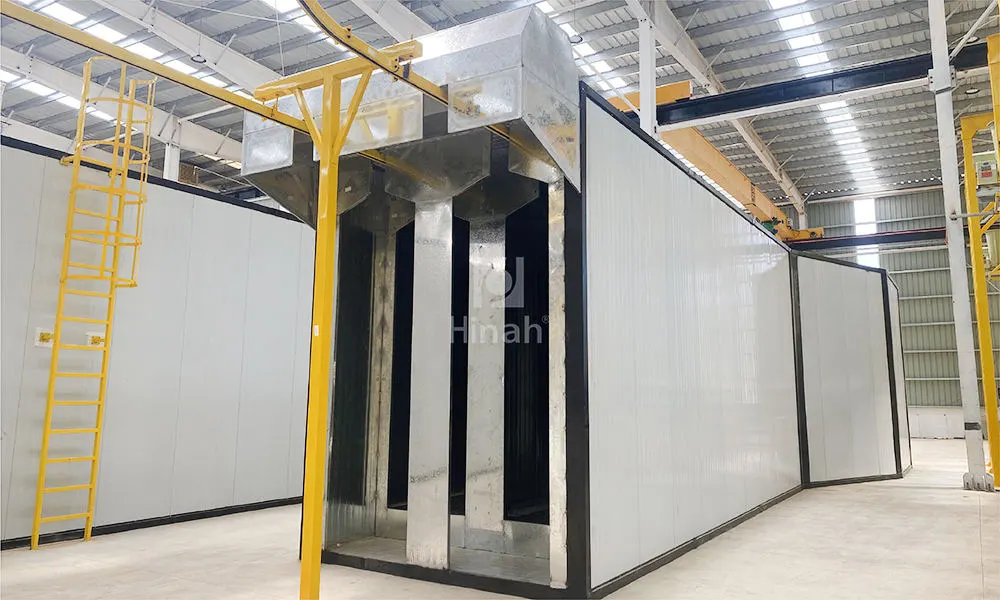
A useful specification begins with the part envelope, substrate thickness range, hanging density, and expected line speed or batch cycle. Coating chemistry, target film thickness, and the supplier’s cure window define the metal-temperature requirement. Utility data, available footprint, ceiling height, exhaust routing, and control integration requirements shape the mechanical design. Validation expectations, documentation language, and operator interface preferences influence the control architecture. Provide representative part drawings and a loaded rack layout, because oven sizing based on average part size often produces a chamber that cannot reach the center of the load. Contact HANNA with this data to structure an inquiry around a powder coating curing oven that supports repeatable cure and measurable quality control.
Frequently Asked Questions
What is the difference between convection and infrared powder coating curing ovens?
Convection ovens heat parts through moving air and generally provide good temperature equalization across complex geometry. Infrared ovens transfer radiant energy directly to surfaces and can shorten heat-up for thin parts, but shadowed areas may receive less energy. Hybrid designs use infrared for initial heat-up and convection for dwell and uniformity.
How long does powder coating need in a curing oven?
The time depends on the coating chemistry, substrate mass, oven airflow, and target metal temperature. A thin panel may reach cure temperature quickly, while a thick casting requires a longer heat-up phase before the dwell begins. The reliable approach is a loaded profile that records part temperature through heat-up and dwell, not a fixed time based on air temperature.
Why do thick parts cure differently from thin parts?
Thick sections absorb more heat before their surface reaches the cure temperature, so they lag behind thin sections during the ramp phase. If the oven dwell is set for the thin parts, the thick sections may remain below the crosslink threshold. Airflow direction, hanging orientation, and part spacing can reduce this difference, and the cure schedule should be based on the slowest-heating representative part.
How can I verify that a powder coating curing oven is delivering a complete cure?
Use part-temperature data from loaded profiles together with coating tests such as MEK rub, impact, adhesion, and gloss. Compare results against the coating supplier’s cure window and keep the profile records with the oven settings. Routine calibration of thermocouples and controllers supports repeatability between production runs.
What data should I provide for a curing oven inquiry?
Provide part drawings, substrate thickness range, rack or hanging layout, required line speed or batch cycle, coating chemistry, target film thickness, cure window, available footprint, utilities, exhaust conditions, and validation expectations. Representative loaded-rack information is especially useful because it defines the heat-transfer challenge more accurately than average part dimensions.
How does part loading density affect oven performance?
Dense loads shield surfaces from moving air and increase the thermal mass inside the chamber. The oven may recover air temperature slowly after the load enters, and the center of the load may heat more slowly than the edges. Adjustable airflow, tested hanging patterns, and loaded-profile validation help match the cure schedule to the actual production load.
For finishing operations that need a documented cure window, stable color and gloss, and a specification process grounded in part geometry and coating chemistry, contact HANNA to discuss your powder coating curing oven requirements and begin an inquiry with the relevant load, line, and validation data.
Related News
Learn More + -
7 Critical Insights into Powder Coating Curing Ovens for Flawless Finishes
Imagine a world where metal products—from automotive parts to household appliances—sport vibrant, durable finishes that resist chipping, fading, and c ...View Details2026-11-06 -

The Ultimate Guide to Powder Coating Curing Ovens: Benefits, Types, and Custom Solutions
If you're in the manufacturing or finishing industry, you know that a powder coating curing oven is the heartbeat of a durable, high-quality finish. T ...View Details2026-11-06 -
How a Powder Coating Curing Oven Works: A Complete Guide for Durable Finishes
Achieving a perfect, durable powder coated finish depends on one crucial stage: the powder coating curing oven. This is where the science happens. The ...View Details2026-11-06 -
5 Things You Must Know About a Powder Coating Curing Oven
A powder coating curing oven is an essential piece of equipment in any finishing line. Its primary job is to apply controlled heat to a coated part. T ...View Details2026-11-06 -
The Science of Powder Coating Curing Oven Systems for High-Performance Finishing
In industrial finishing, the final conversion of powdered polymer into a durable, cross-linked film hinges entirely on the thermal process. A powder ...View Details2026-11-06 -
Powder Coating Curing Oven: Cure Window and Oven Design Guide
Engineering guide to powder coating curing ovens: cure windows, airflow, batch and conveyor designs, validation, and specification data for industrial ...View Details2026-11-27