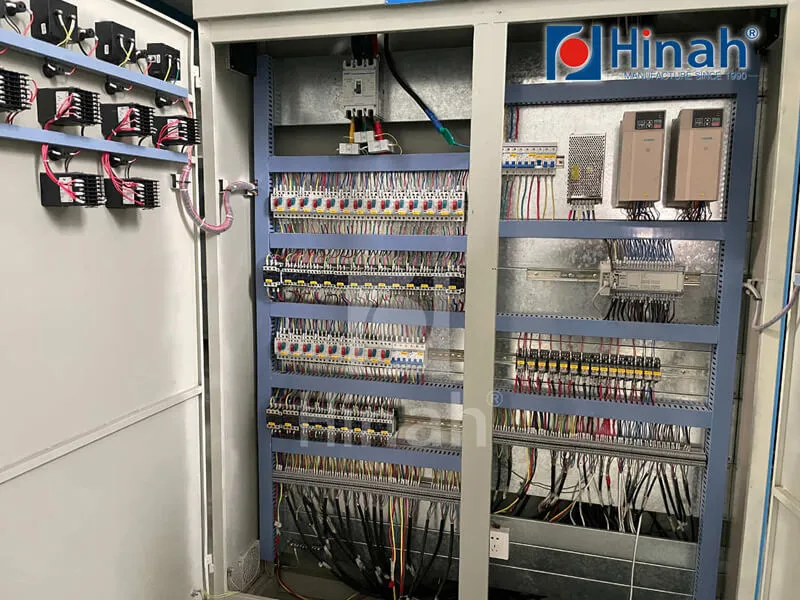

Industrial surface finishing demands strict precision, structural repeatability, and long-term durability. Achieving these standards requires a detailed understanding of both the electrostatic deposition process and the subsequent thermal polymerization of the coating material. A coordinated Powder coating machine and oven system forms the foundation of any modern finishing line. Whether processing architectural aluminum profiles, automotive chassis components, or heavy agricultural machinery, the mechanical interaction between the application equipment and the curing system determines the final quality of the protective film. By understanding the mechanical and thermodynamic principles involved, manufacturers can improve production yields, minimize rework, and maintain strict quality standards. As an industrial system integrator, HANNA engineers integrated coating solutions to address these operational parameters.
The powder application phase relies on electrostatic principles to temporarily adhere dry polymer particles to a conductive, grounded substrate. The efficiency of this process is governed by the charging method, powder fluidization, and delivery mechanics.
Corona charging remains the most common method in industrial coating lines. This system utilizes a high-voltage electrode at the spray gun tip to ionize the surrounding air, creating an electrostatic field. As powder particles pass through this ionized zone, they acquire a negative charge and are drawn toward the grounded workpiece along the electrostatic field lines. While highly effective for high-speed application and compatible with almost all powder chemistries, Corona charging is subject to the Faraday cage effect. This phenomenon prevents charged powder particles from penetrating deep recesses, internal corners, or complex geometries, as the electrostatic field lines naturally concentrate on the outermost grounded edges.
Tribo charging relies on kinetic friction rather than an external power supply. Powder particles are forced through a gun barrel lined with a highly electronegative material, typically polytetrafluoroethylene (PTFE). The rapid friction strips electrons from the powder particles, leaving them with a positive charge. Because this method does not generate an external electrostatic field or free air ions, it effectively eliminates the Faraday cage effect. Powder can easily penetrate deep channels and complex recesses, resulting in a highly uniform coating thickness on intricate parts. However, Tribo charging requires specific powder formulations and experiences faster wear on internal gun components due to the abrasive nature of the powder flowing through the barrel.
Consistent powder delivery is fundamental to achieving a uniform film thickness. Standard industrial systems utilize Venturi-style pumps to transport the powder from a fluidized hopper to the spray gun. In a Venturi pump, compressed air passes through a nozzle, creating a low-pressure zone that draws fluidized powder into the transport hose. The volume of powder delivered is controlled by adjusting the flow air (which determines the powder volume) and the atomizing air (which controls the velocity of the powder cloud).
For high-throughput applications requiring ultra-precise control, dense-phase transport systems are increasingly deployed. These systems utilize high-pressure, low-velocity air to move a highly concentrated mixture of powder through thin-diameter hoses. This minimizes kinetic wear on the pump and gun components, reduces powder pulsation, and provides a highly stable spray pattern over long production runs.
Once the electrostatic attraction holds the dry powder onto the substrate, the parts must enter the curing phase. The selection and configuration of a Powder coating machine and oven assembly must match the mass and composition of the substrate to ensure proper thermal transfer and polymer cross-linking.
Convection ovens are the industry standard for high-volume, variable-geometry parts. These systems use burner chambers fueled by natural gas, liquefied petroleum gas (LPG), or electricity to heat air, which is then circulated throughout the oven chamber by heavy-duty blowers. The heat is transferred to the substrate via thermal convection. The primary advantage of convection curing is its versatility; as long as the air temperature is maintained uniformly, parts of any shape or size will eventually reach the target temperature. However, convection heating is relatively slow, as the entire mass of the metal substrate must be heated to the curing temperature before the powder resin begins to melt and cross-link.
Infrared curing utilizes radiant electromagnetic waves to directly heat the powder layer and the immediate surface of the metal without relying on air as a heating medium. This permits exceptionally rapid heating times and significantly shorter curing cycles. Despite these advantages, IR curing is highly line-of-sight dependent. Complex three-dimensional shapes can experience thermal shadowing, where certain surfaces receive less radiant energy, resulting in under-cured zones. Consequently, high-performance lines often implement hybrid systems, which combine an initial IR zone to rapidly gel the powder followed by a convection zone to complete the curing cycle.
In convection ovens, the design of the ductwork and the velocity of the circulating air are crucial engineering parameters. If the airflow velocity is too high, it can physically dislodge the dry, uncured powder from the parts, contaminating the oven interior and creating surface defects on the finished product. To prevent this, industrial ovens are designed with high-volume, low-velocity laminar airflow distribution systems.
Temperature uniformity is verified using traveling temperature data loggers that pass through the oven with the product. Thermocouples are attached to multiple points on both thin and thick sections of the test part. The resulting thermal profile curve must show that all areas of the substrate reached the specified curing temperature (typically between 160°C and 200°C) and maintained it for the duration recommended by the powder manufacturer. Below is an engineering comparison of curing methods:
| Parameter | Convection Curing Ovens | Infrared (IR) Curing Ovens | Hybrid Curing Ovens |
|---|---|---|---|
| Heat Transfer Medium | Circulated Hot Air | Radiant Energy Waves | Radiant Waves followed by Hot Air |
| Heating Speed | Slow to Moderate | Extremely Rapid | Rapid Initial Gel, Steady Cure |
| Geometry Suitability | Excellent for Complex 3D Shapes | Best for Flat or Simple 2D Shapes | Highly Adaptable to Mixed Geometries |
| Risk of Powder Blow-off | Low to Moderate (requires tuning) | None | Minimized (powder is gelled first) |
Inconsistent finish quality often stems from a lack of coordination between the application phase and the curing cycle. By examining the process as a combined Powder coating machine and oven workflow, operators can identify and eliminate common quality issues.
The textured profile known as "orange peel" occurs when the powder particles do not flow out into a smooth, continuous film during the initial melt phase. This defect can be caused by improper voltage settings on the electrostatic gun, leading to back-ionization, or by a heating rate that is too slow in the curing oven. If the temperature rise of the substrate inside the oven is too slow, the thermosetting resin begins to cross-link and increase in viscosity before it has fully melted and leveled. To resolve this, operators must calibrate the oven's heating curves to match the specific thermal mass of the parts, ensuring a rapid transition through the resin's gel point.
Poor mechanical adhesion, low impact resistance, and chemical susceptibility are typical indicators of incomplete cure. This occurs when the substrate does not spend sufficient time at the powder manufacturer's specified cure temperature (e.g., 10 minutes at 180°C metal temperature). It is a common mistake to assume that the oven air temperature equals the substrate temperature. Thicker metal sections require longer dwell times to reach the target temperature. Integrating an advanced Powder coating machine and oven setup helps ensure that curing calculations are based on actual metal temperature profiles rather than air temperatures alone. High-performance electrostatic systems manufactured by HANNA utilize advanced control loops to synchronize application and curing parameters.
Maximizing throughput in high-volume industrial facilities requires seamless mechanical integration between the powder booth, the curing oven, and the conveyor system.
Different industries present unique demands regarding substrate materials, production volumes, and environmental exposure. The configuration of the finishing line must be tailored to these specific operational requirements.
Components such as agricultural equipment frames, structural steel columns, and heavy industrial valves are subjected to harsh environmental conditions and mechanical wear. These parts require thick protective coatings with high corrosion resistance. The application system must deliver high powder volumes with wrap characteristics, while the curing oven must be engineered to heat massive steel sections uniformly without overheating adjacent thinner sections.
Architectural extrusions demand exceptional aesthetic quality, color consistency, and UV resistance. For these materials, precise temperature control within the oven is necessary to avoid yellowing of clear coats or variations in gloss levels across different production batches. When coating galvanized steel, outgassing is a common concern. Moisture or gases trapped within the zinc layer can escape during heating, creating pinholes in the cured coating. Utilizing a pre-heating phase or selecting a specialized formulation applied with custom-engineered Powder coating machine and oven lines helps mitigate this phenomenon.
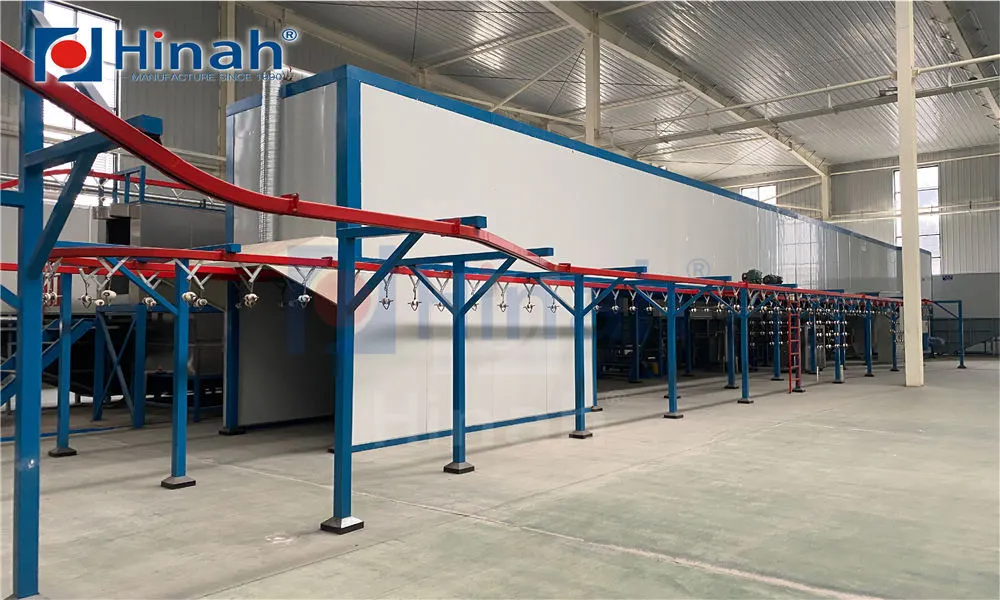
Every manufacturing facility has unique spatial constraints, throughput targets, and product geometries. Achieving a reliable, high-yield finishing process requires an engineered solution tailored to these specific operational parameters. Systems manufactured by HANNA can accommodate custom conveyor layouts, advanced PLC integrations, and specialized airflow designs. To receive a detailed proposal, technical schematics, and customized layout options for your production line, submit an inquiry to our application engineering team with your part dimensions, material compositions, and desired production capacity.
Q1: What is the main cause of uneven film thickness across a single part?
A1: Uneven film thickness is typically caused by inconsistent powder output from the spray gun or improper electrostatic grounding. If the powder pump is worn or the fluidizing hopper has uneven air distribution, the powder feed will pulsate. Additionally, poor grounding of the hanger racks limits the electrostatic attraction, causing powder to build up on closer surfaces while neglecting shadowed areas.
Q2: How is the correct curing temperature for a specific part determined?
A2: The correct curing temperature is determined by measuring the substrate (metal) temperature, not the oven air temperature. This is achieved by attaching thermal probes directly to the thickest and thinnest sections of the part and running it through the oven with a temperature data logger. The heating curve must show that all areas of the substrate reached the specified curing temperature (e.g., 180°C) and maintained it for the duration recommended by the powder manufacturer.
Q3: What is the difference between a batch oven and a continuous conveyor oven?
A3: A batch oven is a stationary chamber where parts are loaded manually, cured for a set period, and then unloaded. It is highly flexible and suitable for low-volume, high-variety production or exceptionally large parts. A continuous conveyor oven features openings at both ends and uses a conveyor system to transport parts through the heated zone at a constant speed, making it suitable for high-volume, automated production lines.
Q4: How does the Faraday cage effect impact the powder coating process?
A4: The Faraday cage effect occurs when an electrostatic field prevents charged powder particles from entering recessed areas, internal corners, or slots. The particles are instead drawn to the grounded edges of the recess. This can be resolved by adjusting the gun settings to a lower voltage and higher current, increasing the distance between the gun and the part, or utilizing a Tribo charging system which does not rely on an external electrostatic field.
Q5: Why is airflow velocity important inside a powder curing oven?
A5: High airflow velocity can dislodge the dry, uncured powder from the substrate before it has melted and gelled, leading to thin spots on the part and contamination inside the oven chamber. Conversely, too little airflow can lead to temperature stratification, where hot air rises to the top of the oven, leaving the bottom of the chamber too cool to achieve a proper cure. A balanced, low-velocity, high-volume air distribution system is necessary to maintain thermal uniformity.