
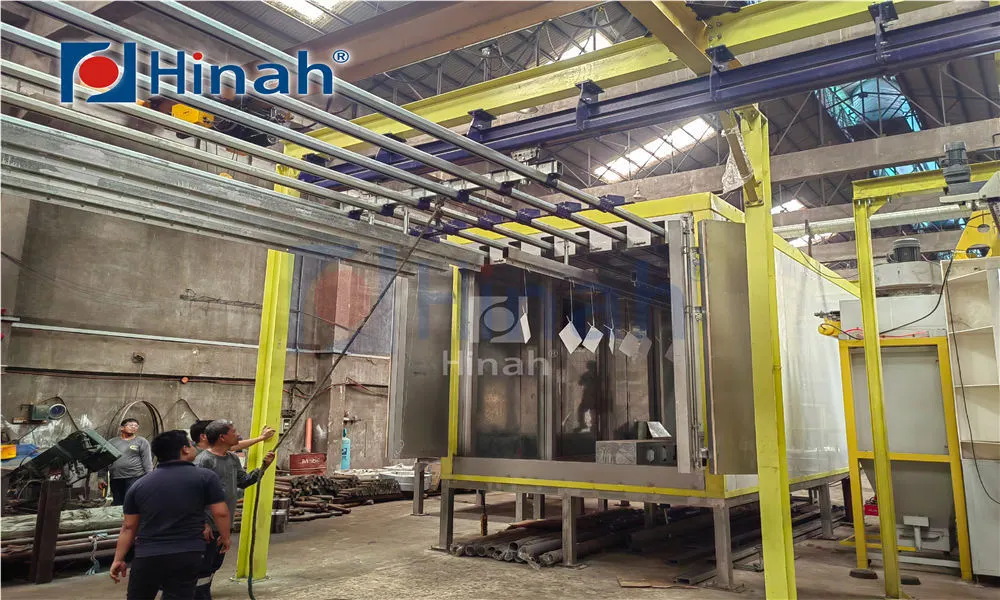
For workshops with limited floor space, a small powder coating booth is the cornerstone of modern surface finishing. HANNA has engineered these booths to deliver consistent, high‑quality results without occupying your entire production area. Whether you are coating prototypes, automotive parts, or custom furniture, a compact booth ensures a clean, safe, and professional environment. In this article we explore why investing in a compact booth can streamline your operations and boost your coating quality.
A small powder coating booth brings large‑scale efficiency to tight spaces. It contains overspray, protects operators from airborne particles, and guarantees a smooth finish on every workpiece. HANNA designs these booths to integrate seamlessly into job shops, R&D labs, and small manufacturing cells. They are easy to install, require minimal ventilation modifications, and can be moved if your layout changes.
Traditional booths demand extensive floor space and complex ductwork. A small powder coating booth from HANNA fits through standard doorways and operates in areas as compact as 10 m². The footprint is optimised without compromising on filtration quality or operator comfort.
Despite its size, HANNA’s booth uses multistage filtration – including polyester cartridge filters – to capture 99.9% of powder particles. Clean air is recirculated back into the workspace, reducing heating/cooling losses and keeping your environment compliant with safety standards.
Cartridge filters with automatic pulse cleaning
Quick‑release filter doors for easy maintenance
Low noise level during operation
Choosing a compact booth offers benefits that go beyond saving space. It directly impacts productivity, colour change speed, and energy consumption. Below are the main advantages you can expect from HANNA’s engineering.
One common concern with small booths is colour contamination. HANNA has addressed this with smooth interior walls and a streamlined airflow pattern. Operators can switch colours in under 10 minutes without disassembling the booth. This makes a small powder coating booth ideal for job shops that handle multiple colours daily.
Less air volume to move means lower fan power requirements. HANNA’s booth uses variable‑speed drives that automatically adjust airflow based on the part size. Users report up to 30% savings on electricity compared to conventional booths.
Reduced heated/cooled air loss
Lower carbon footprint
Quieter operation thanks to optimised fans
Not all compact booths are created equal. To get the best return on investment, consider these critical factors when evaluating a small powder coating booth.
Measure your largest part and estimate daily volume. HANNA offers modular widths from 1.5 m to 3 m, with depth options that allow both batch and continuous operation. If you occasionally run longer parts, a pass‑through configuration might be necessary.
Check local regulations for particulate排放 (emissions). HANNA’s booths are equipped with HEPA after‑filters (optional) to meet the strictest standards. Also ensure the booth’s air velocity (typically 0.5–0.7 m/s) provides adequate containment while avoiding powder disturbance on the part.
Choose between manual or automatic powder recovery
Consider explosion venting if spraying combustible powders
Verify the booth’s construction material – stainless steel or galvanised
A small powder coating booth is versatile enough to serve diverse sectors. HANNA has supplied units to automotive refinishers, architectural metal workshops, and even electronics manufacturers. Here are some common uses:
Automotive: coating wheels, brake calipers, engine brackets
Furniture: finishing chair frames, table legs, shelving
General engineering: prototypes, machine guards, enclosures
Electronics: enclosures for servers, medical devices, instrumentation
Because the booth occupies little space, it is also popular in university labs and vocational training centres where students learn powder coating techniques safely.
Operating a small powder coating booth requires routine checks to maintain performance and safety. HANNA recommends the following schedule:
Inspect filters for blockages; clean if pressure drop exceeds limits
Check door seals and gaskets for wear
Ensure extraction fan is running at correct speed
Clean booth interior with a non‑metallic scraper to prevent powder buildup
Test ground continuity on all conductive parts
Verify that the pulse‑jet timer is functioning
Replace cartridge filters (depending on usage)
Inspect and lubricate fan bearings
Calibrate pressure gauges and sensors
HANNA provides detailed manuals and remote support to help you keep your booth in top condition.
From space utilisation to energy savings, a small powder coating booth from HANNA delivers professional results without the footprint of traditional systems. Our booths are built to last, easy to maintain, and backed by a global support network. Whether you are starting a new coating line or upgrading an existing one, HANNA offers the perfect balance of size and performance. Visit HANNA to explore our full range of finishing solutions.
Q1: What is the smallest footprint available for a small powder coating booth?
A1: HANNA offers booths as compact as 1.5 m (width) × 1.2 m (depth) × 2.2 m (height). These can fit into almost any workshop corner while still allowing an operator to move comfortably around the part.
Q2: Can a small powder coating booth handle high‑volume production?
A2: Yes. Although the booth is compact, HANNA designs it for continuous operation. With fast colour change and automatic powder recovery, many users achieve throughput comparable to larger booths for small‑ to medium‑sized parts.
Q3: What safety features are included?
A3: Every HANNA booth comes with explosion relief panels (where required), spark‑resistant construction, and grounding points. The filtration system prevents combustible dust accumulation, and optional fire suppression systems can be integrated.
Q4: How often should I replace the filters in a small powder coating booth?
A4: Cartridge filters typically last 6 to 12 months with regular cleaning, depending on usage. HANNA’s differential pressure gauge tells you exactly when replacement is needed – usually when pressure drop exceeds 1200 Pa after pulsing.
Q5: Is installation complicated?
A5: Not at all. HANNA supplies the booth in pre‑assembled modules that bolt together. Most customers complete installation in one day with basic tools. Electrical connections are straightforward, and our technical team is available for remote guidance.