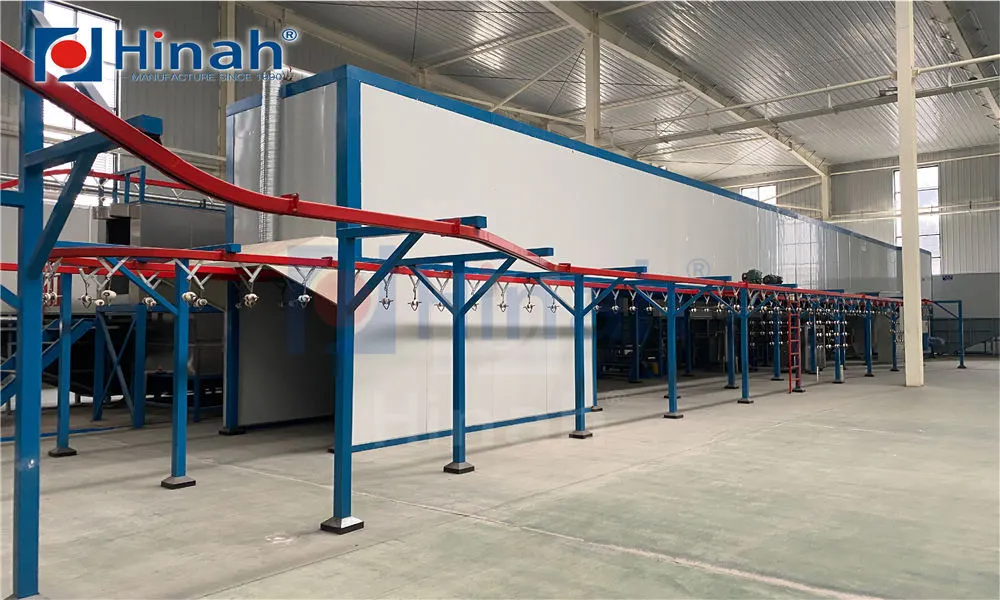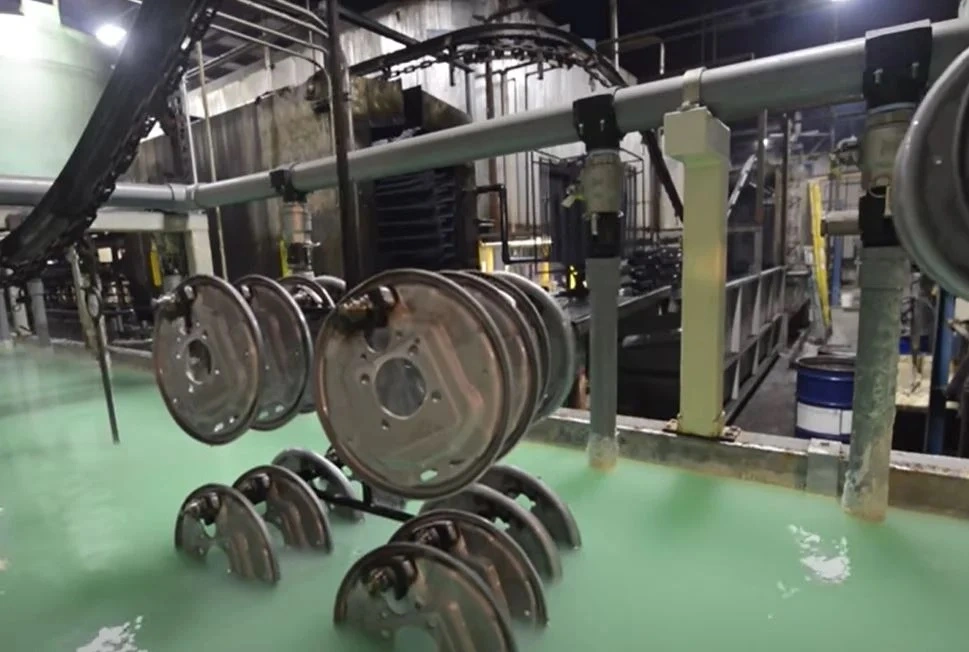
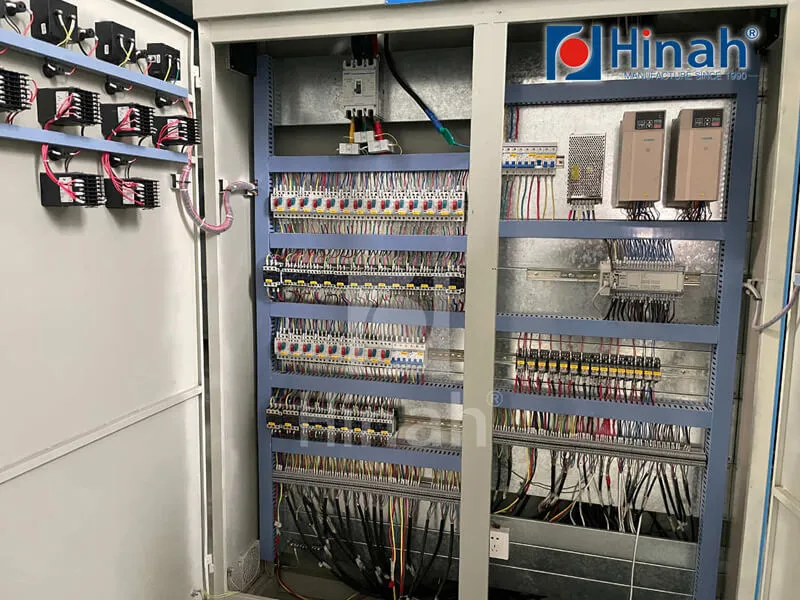

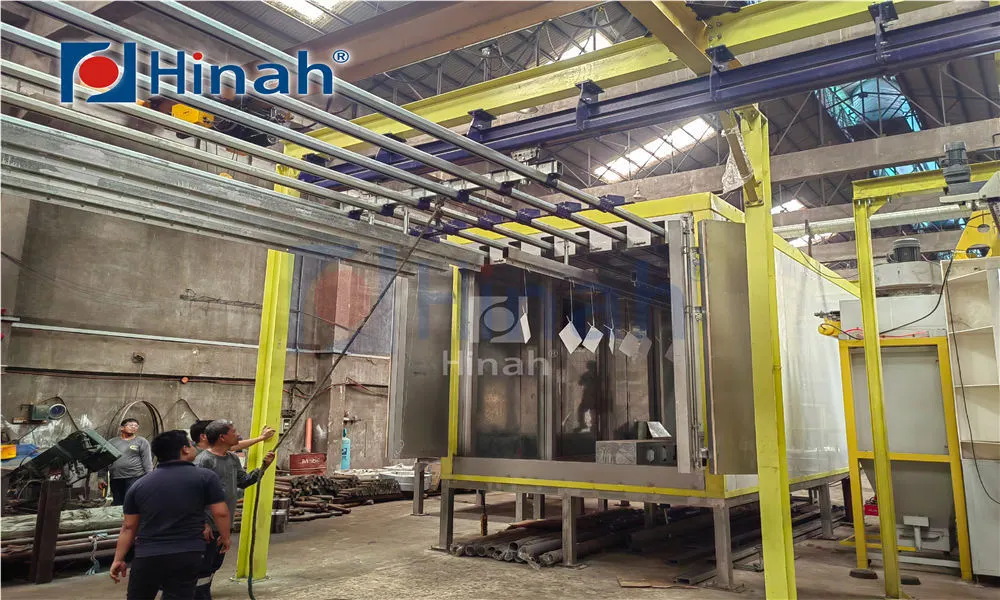
In modern industrial finishing, the transition from manual spraying to an automatic powder coating line is not merely an upgrade—it is a strategic move to control variables that directly affect rejection rates, powder consumption, and labor costs. For operations coating hundreds of thousands of parts monthly (from automotive chassis to aluminum extrusions), the line must deliver repeatable film thickness, handle complex part geometries, and minimize color change downtime. HANNA has engineered such systems for two decades, integrating closed-loop controls and modular conveyor architectures that adapt to high-mix, mid-to-high volume environments.
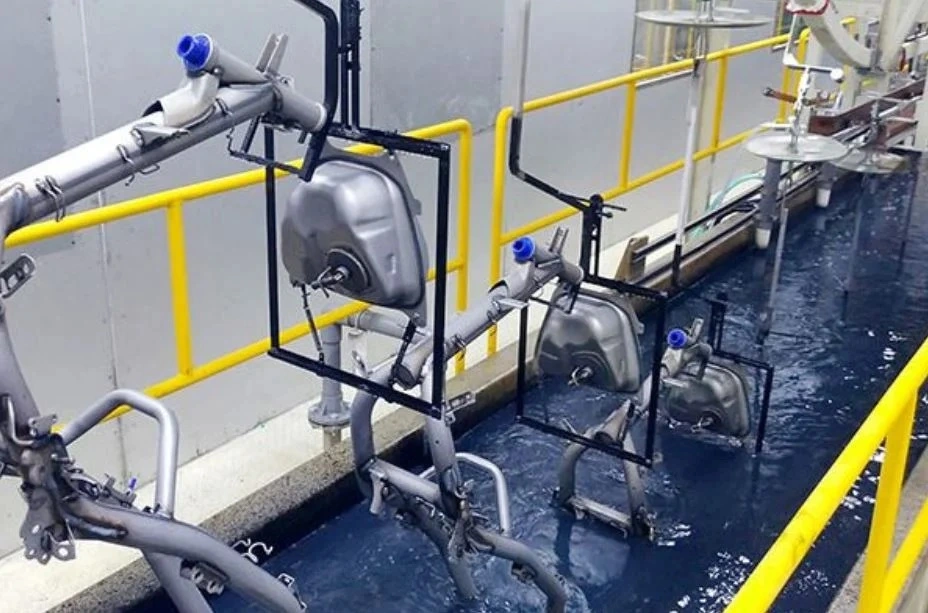
An efficient line is not a collection of standalone machines but a synchronized material handling and curing ecosystem. The typical sequence includes:
Pretreatment (chemical or mechanical): Washing, phosphating, or silane application to ensure adhesion and corrosion resistance.
Dry-off oven: Removing moisture before powder application; usually a convection or IR zone.
Automatic powder spray booth(s): Equipped with reciprocating guns, multi-cyclone or cartridge recovery, and color change modules.
High-recovery powder management unit: Sieving and feeding virgin + reclaim powder to the spray guns.
Curing oven: Gas-fired or electric convection oven with precise temperature zoning (typically 10–20 minutes at 180–200°C).
Overhead or floor-mounted conveyor: I-beam, power-and-free, or monorail with variable speed control.
The difference between a basic line and a truly automatic powder coating line lies in closed-loop feedback. For instance, HANNA integrates laser-based part profiling sensors that adjust gun stroke, voltage, and powder output in real time, compensating for part hollowness or proximity variations. This alone reduces over-spray by 12–18% compared to fixed-gun setups.
Having commissioned over 90 lines globally, we observe recurring challenges that derail ROI projections. Below are the top three issues and their engineering solutions within an automated line.
Pain point: Manual cleaning of booth, guns, and powder hoses
can take 45–90 minutes per color change, drastically reducing OEE.
Solution: A modular booth design with quick-release powder
feed hoppers, compressed-air purge rings, and a dedicated reclaim cyclone for
each color. HANNA’s “rapid-switch” booths enable color changes in under 8
minutes for medium-complexity setups, using separate suction ducts and automated
gun washing. For lines requiring 5+ changes per shift, we recommend a powder coating
plant with multiple small booths on a turntable, where one booth is
active while the adjacent is being cleaned.
Pain point: Recessed areas (corners, internal cavities)
receive 30–50% less powder than flat surfaces, leading to premature corrosion.
Solution: Automatic lines must deploy asymmetric
electrostatic charging. HANNA’s nano-gun technology (patented) modulates the kV
and microamperage between 40–85 kV depending on part geometry detected by a 3D
vision system. Additionally, secondary reciprocators with extended nozzles at
45° angles are placed at strategic positions to force powder into recesses. For
mission-critical parts (e.g., agricultural machinery brackets), we integrate an
oscillating bell system that creates a cloud effect, improving penetration by
40% without increasing film thickness on edges.
Pain point: Traditional lines waste 25–40% of sprayed powder
due to overspray and inefficient recovery.
Solution: A
closed-loop reclaim system with a cyclonic separator (efficiency >98% for
particles >10µm) and automatic sieving. The automatic
powder coating line from HANNA includes a mass-flow sensor that
continuously monitors the reclaim-to-virgin ratio, maintaining a 70/30 mix to
prevent contamination while cutting material cost by up to 22%. Furthermore, the
booth’s airflow design (down-draft with 0.4–0.6 m/s velocity) ensures that
overspray is immediately drawn into recovery cyclones, not settling on walls or
the conveyor.
Even the most sophisticated spray booth is worthless if the conveyor indexing creates gaps or if the curing oven has cold zones. For an automatic line to achieve first-pass yield >96%, pay attention to:
Load density optimization: HANNA’s line simulation software calculates maximum hanger utilization without part collision, automatically spacing carriers during color change sequences.
Infrared + convection hybrid ovens: For thick-walled parts (cast iron, extruded aluminum), IR panels in the first zone raise surface temperature to 130°C within 90 seconds, preventing under-cure in shadow areas. The convection zone then holds the part at 190°C ±2°C using thermocouples placed on dummy parts on the line.
Energy recovery: A heat exchanger captures exhaust from the curing oven to preheat the dry-off oven, reducing gas consumption by 15–18%. This is standard in HANNA’s turnkey powder coating plant designs for European energy efficiency standards.
Not every factory requires full autonomy. We classify automatic powder coating lines into three tiers:
Tier 1 (Basic automation): Fixed reciprocators, manual powder loading, and batch curing. Suitable for 8–12 color changes per week, 2–4 operators per shift. ROI period: 12–18 months.
Tier 2 (High automation – most common): PLC-controlled conveyor speed, automatic gun adjustment per part, color change in <10 min, and recipe storage for 200+ SKUs. HANNA’s Tier 2 lines include remote diagnostics and powder consumption reporting. ROI: 18–24 months.
Tier 3 (Lights-out capable): AI-driven part recognition, automatic hanger cleaning, robotic part loading/unloading, and automatic powder hopper refill from bulk silos. Only 1 technician per shift. ROI: 30–36 months, but necessary for 3-shift operations with low color mix.
For most job shops coating automotive, agricultural, and HVAC parts, a Tier 2 line offers the best balance. For instance, a recent HANNA installation in Ohio processes 12,000 parts per shift (eight colors) with a first-pass yield of 97.2% and powder utilization rate of 89%.
Total cost of ownership extends beyond purchase price. Our engineering focuses on three long-term savings:
Powder savings through precision dosing: The automatic powder coating line uses mass-flow controllers (Coriolis type) on each gun, adjusting output within 20ms. Compared to volumetric feeders, this reduces overspray by 11%.
Conveyor maintenance reduction: HANNA uses sealed-bearing trolleys and auto-lubrication systems on power-and-free conveyors. Mean time between failures (MTBF) exceeds 8,000 hours.
Modular expansion: Every line is built with pre-drilled mounting points for additional spray booths or cooling tunnels. Adding a second color booth later does not require structural changes.
Furthermore, all lines come with a 5-year structural warranty on the oven and conveyor track—a reflection of the heavy-gauge steel and 304 stainless liners used in zones exposed to powder and chemicals.
Client: Tier 1 automotive suspension component supplier
(Mexico)
Parts: Control arms, stabilizer bars (3–8 kg each),
20 colors, 22,000 parts/day.
Challenge: Manual line had 14%
rejection due to thin coating on internal edges and inconsistent color
matching.
HANNA solution: A 120-meter automatic powder
coating line with six spray guns (two asymmetric reciprocators), automatic part
rotation spindles, and a multi-cyclone reclaim system.
Results after
6 months: First-pass yield increased to 96.8%, powder consumption per
part dropped 19%, color change time reduced from 55 minutes to 11 minutes.
Annual savings: $440,000 in material and rework costs.
Q1: What is the typical lead time for a custom automatic powder
coating line?
A1: For a mid-sized Tier 2 line (30–40 m booth length,
80–120 m total conveyor length), lead time ranges from 12 to 20 weeks. HANNA
offers a fast-track option (8 weeks) for standardized modules. Custom lines with
special oven zoning or cleanroom specs take 20–24 weeks.
Q2: Can your automatic line handle both small (50 parts) and large
(5,000 parts) batches efficiently?
A2: Yes. Our lines incorporate
recipe-driven conveyor spacing and variable booth air flow. For small batches,
the system automatically reduces line speed and activates only one reciprocator
to minimize powder waste. For large batches, full gun array and high conveyor
speed (up to 6 m/min) are used. No manual changeover is needed.
Q3: What maintenance is required weekly for an automatic powder
coating line?
A3: Standard weekly tasks: (1) Clean spray gun
electrodes and nozzles; (2) Inspect cyclone separator seals; (3) Check conveyor
chain tension and lubricate bearings; (4) Verify oven temperature uniformity
with a traversing thermocouple; (5) Change powder filters if differential
pressure exceeds 1.5 kPa. HANNA provides a digital maintenance log with
automatic reminders.
Q4: How does your line integrate with existing pretreatment or curing
ovens?
A4: We supply interface adapters (conveyor height matching,
speed synchronization PLC modules) to integrate with third-party washers or
ovens. The HANNA control cabinet includes digital I/O slots to read/write
signals from existing equipment. Full integration typically takes two days of
on-site commissioning.
Q5: What types of powder chemistries can the line process without
cross-contamination?
A5: Our lines handle epoxy, polyester, hybrid,
polyurethane, TGIC-free, and low-temperature cure (130°C) powders. For
anti-microbial or food-contact powders, we offer a dedicated sanitary design
with 316L stainless steel contact surfaces and a separate reclaim cyclone. Color
change protocols include full air purge and wipe-down of non-stick booth
panels.
Q6: Is the automatic powder coating line energy-efficient compared to
manual lines?
A6: Yes. An automatic line reduces compressed air
consumption by up to 40% because the guns only spray when parts are present
(photocell triggered). Additionally, the curing oven is insulated with 150 mm
rockwool and uses variable-frequency drives on exhaust fans. Many HANNA lines
achieve EU Ecodesign directive compliance with specific energy consumption below
0.35 kWh/kg of coated parts.
Q7: What training and documentation do you provide?
A7:
We provide a 3-day on-site training for operators and maintenance staff (powder
flow settings, gun cleaning, conveyor troubleshooting). Documentation includes a
full electrical schematic, PLC ladder logic printout, and a spare parts list
with 3D exploded views. Remote support is available via VPN connection to the
line’s HMI.
An automatic powder coating line is not a commodity—it is a tightly integrated system that must match your part mix, required throughput, and available floor space. HANNA provides a detailed process simulation and cost-savings projection before any equipment is built. Our engineering team will analyze your current rejection rates, powder usage, and labor costs to propose a line with guaranteed first-pass yield ≥95%.
Request your customized quotation today: Share your part drawings, desired daily output, and color change frequency. We will respond within 48 hours with a line layout, ROI calculation, and a firm delivery schedule.
Send an Inquiry to HANNA Engineering