
The integration of powder coating robots into industrial finishing lines represents a significant departure from both manual hand-spray operations and traditional fixed-gun reciprocators. While the chemistry of thermoset powders remains constant, the method of delivery—governed by six-axis kinematic precision and closed-loop process control—fundamentally alters the economics of the coating cell. For operations managers navigating tightening volatile organic compound (VOC) regulations and persistent labor shortages, the shift toward robotic application is no longer a speculative venture; it is a calculated engineering response to the demand for consistent film build and reduced material waste.
This technical discussion examines the operational characteristics of powder coating robots, moving past promotional claims to analyze the tangible metrics that define performance: First Pass Transfer Efficiency (FPTE), Mean Film Thickness Deviation, and Gun-on-Time Optimization. For a powder coating plant aiming to achieve automotive-tier finish standards on complex geometries, a deep comprehension of robotic tool path logic and electrostatic field management is mandatory.

1. Kinematic Reach and The Challenge of Complex Substrate Coverage
Fixed automation—reciprocators and oscillators—operates within a narrow two-dimensional plane. They are effective for flat panel stock or simple extrusions but fall short when confronted with deep recesses, interior corners, or convoluted weldments common in agricultural equipment and chassis components. Powder coating robots, typically six-axis articulated arms, circumvent these limitations through dexterous path planning.
The kinematic redundancy of a six-axis arm allows the electrostatic spray gun to maintain a constant, perpendicular standoff distance relative to the target surface, even as the part curves or steps inward. This is not merely a geometric convenience; it is a requirement for film uniformity. Variations in gun-to-target distance—inevitable with reciprocator stroking over a contoured part—result in measurable differences in electrostatic field strength. According to Coulomb's law, field strength declines with the square of the distance. A robotic path that holds ±15mm tolerance ensures the powder cloud velocity and attraction force remain within a controlled envelope, eliminating the "Faraday cage" shadowing effect in tight radii that plagues simpler automation.
2. Electrostatic Parameter Control and Gun Trigger Logic
The value of powder coating robots extends beyond positional accuracy to encompass dynamic process variable adjustment. In a manual or fixed-gun setup, parameters such as kilovolt (kV) output and micro-amperage (µA) feedback remain largely static regardless of part geometry. Robotic systems, integrated with the powder application controller, enable programmable trigger profiles.
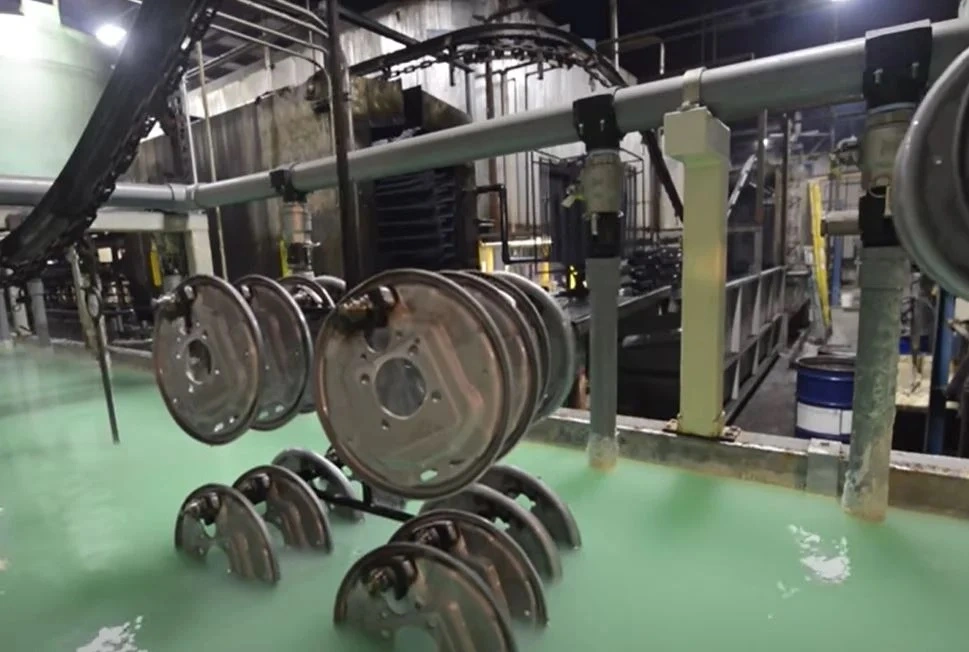
Consider the application on a wheel rim:
Exterior Rim Face: High kV (70-90 kV) with high powder flow rate to achieve rapid coverage on a visible Class A surface.
Interior Barrel and Lug Nuts Recess: The robot program automatically reduces kV to 30-40 kV and lowers powder output. This is known as "back-ionization prevention." In confined metallic spaces, excessive kV creates an ionized wind that repels incoming powder particles, leading to a thin, grainy texture or "starring" around holes. The robot's logic prevents this defect by dialing back voltage precisely where needed.
Edge Blow-Off Mitigation: On sharp edges, the program may engage a brief blast of shaping air or a slight reduction in electrostatic charge to prevent powder from wrapping excessively around the corner and sagging during cure.
HANNA has documented in field studies that this level of dynamic control reduces overspray particulate by 12-18% compared to reciprocators operating with a fixed setpoint.
3. First Pass Transfer Efficiency (FPTE) and Material Utilization Economics
Material cost represents the single largest variable expense in a powder coating plant operation. Powder overspray—while reclaimable—incurs costs in cyclone recovery energy, sieve screen maintenance, and eventual degradation of particle size distribution (PSD) in the reclaim blend. High-performance powder coating robots optimize material usage through two specific mechanisms:
Precision Fluidization and Dense Phase Transport: Robotic systems utilize closed-loop feedback from the powder pump to maintain consistent powder velocity in the hose. Variations in hose length or bends in manual setups lead to "spitting" or pulsation. Robotic consistency ensures the gun nozzle outputs a homogeneous cloud at all times.
Minimized "Spray-to-Waste": A robot does not spray air. Using gun triggering software, the powder flow is switched on milliseconds before the gun enters the part envelope and switched off precisely at the part edge. In contrast, reciprocators must stroke beyond the part edge to ensure coverage at the ends, blasting powder into the empty booth recovery system.
Quantitative analysis of powder usage in mixed-part production shows that powder coating robots can shift the ratio of virgin-to-reclaim powder from a typical 60/40 split closer to an 80/20 split, preserving the finer particle distribution essential for high-gloss finishes.
4. Offline Programming and Rapid Product Changeover
A persistent concern among job shop coaters is the perceived downtime associated with programming a robot for a new part number. Historically, this involved "teach pendant" jogging—a tedious process halting production. The current state of the art employs Offline Programming (OLP) software integrated with 3D CAD models of the workpiece.
This approach transforms changeover efficiency:
Virtual Path Generation: An engineer creates the robot motion path, gun angles, and trigger points in a virtual environment while the physical robot continues coating the previous batch.
Collision Detection Simulation: The software simulates the full reach envelope to prevent the robot wrist from colliding with the booth walls, conveyor hooks, or the part itself—a common risk when manually jogging a 6-axis arm near obstructions.
Automatic Singularity Avoidance: OLP algorithms prevent the robot joints from aligning in a "locked" position (singularity) where smooth motion becomes impossible, ensuring fluid, even coating strokes.
For high-mix, low-volume manufacturers, this capability reduces changeover downtime from hours to mere minutes—the time required to load the new program and verify gun nozzle clearance.
5. Integration with Digital Factory Infrastructure
Modern powder coating robots function as data acquisition nodes within the broader Industrial Internet of Things (IIoT) ecosystem. The controller tracks metrics that manual sprayers simply cannot quantify:
Actual vs. Programmed Speed: Monitoring servo motor torque to detect mechanical wear in the wrist assembly before it causes path deviation.
High Voltage Feedback Logging: Archiving kV/µA data for every second of production. This provides auditable proof that parts were coated within the Process Capability Window (Cpk > 1.33) required for OEM quality certifications.
Preventive Maintenance Scheduling: Automated alerts based on gearbox duty cycles rather than fixed calendar intervals, reducing unplanned outages.
Connecting this data to a Manufacturing Execution System (MES) allows a powder coating plant manager to trace a coating defect back not just to a specific date, but to a specific robot program revision and environmental condition snapshot.
6. Ergonomic Mitigation and Workforce Sustainability
While technical metrics dominate the justification for automation, the human factor remains a silent driver of adoption. Manual powder coating is physically demanding labor, requiring operators to wear full Tyvek suits, respirators, and manipulate a heavy hose against recoil forces for an entire shift. The result is high turnover, inconsistent film thickness due to operator fatigue, and a shrinking pool of skilled finishers.
HANNA has observed that facilities implementing powder coating robots repurpose their skilled workforce from application labor to quality assurance and robotic supervision. This shift increases job satisfaction, reduces repetitive strain injury claims, and ensures that the coating process is governed by repeatable mechanical precision rather than the variable stamina of the human arm.
The robot does not replace the human expert; it amplifies their capability by executing the physical motion with sub-millimeter repeatability, allowing the technician to focus on optimizing the electrostatic parameters and powder formulation.
Moving Beyond Manual Variability
The deployment of powder coating robots represents a convergence of mechanical engineering, fluid dynamics (powder transport), and software intelligence. The primary objective is not merely the elimination of labor but the eradication of process variation. A robotic cell provides the closed-loop feedback and kinematic precision necessary to apply a uniform 2.5 mil film across a welded assembly, day after day, without the gradual drift inherent in human operation.
For industrial finishers evaluating capital equipment, the decision matrix should weigh the cost of current material waste (overspray), the expense of rework due to inadequate coverage, and the opportunity cost of a production bottleneck at the coating stage. In many high-volume or high-complexity scenarios, the data substantiates a clear advantage for automated kinematic delivery over static or manual alternatives. HANNA continues to advise that a thorough part analysis and return on investment calculation based on Total Applied Cost per Square Foot—not just equipment price—is the appropriate metric for evaluating this technology.
Frequently Asked Questions: Powder Coating Robots
Q1: What is the typical return on investment (ROI) timeline for a powder coating robot cell?
A1: ROI varies based on production volume and current material waste levels. For a single-shift operation replacing two manual sprayers, payback is commonly achieved within 14 to 24 months. This calculation factors in direct labor savings, reduced powder consumption (10-25% typical), and decreased costs associated with reject rework. Powder coating robots configured with high-transfer-efficiency dense phase pumps accelerate this timeline.
Q2: Can a robot effectively coat complex geometries with deep Faraday cage areas?
A2: Yes, but the programming strategy differs significantly from coating flat panels. To coat recessed boxes or deep channels, the robot program reduces electrostatic voltage (kV) and lowers powder output while moving the gun closer to the aperture. This technique minimizes the ionized air cushion that repels powder. In some cases, a specialized nozzle extension or "paddle" gun attachment is automatically exchanged by the robot tool changer.
Q3: How difficult is it to program a new part shape?
A3: For operations using Offline Programming (OLP) software with 3D CAD import, a new part program can be generated in 2-4 hours on a workstation. Touch-up and fine-tuning of the program at the actual booth may take an additional hour. For simple, symmetrical parts, the teach pendant method remains viable for rapid, on-the-fly adjustments.
Q4: Is robotic powder coating only viable for large, high-volume manufacturers?
A4: While high-volume automotive tier suppliers were early adopters, the cost of entry-level 6-axis robots and simplified control interfaces has made the technology accessible to job shops processing batches of 50-100 parts. The ability to store an infinite library of part recipes makes robotic automation particularly valuable for shops with high part number diversity but moderate annual volumes per part.
Q5: What maintenance is required to keep the robot operating reliably in a dusty powder environment?
A5: Powder coating robots intended for this environment feature a pressurized purge system within the arm casting. A small flow of clean, dry air is maintained inside the robot wrist and upper arm to create positive pressure, preventing airborne powder fines from infiltrating the seals and bearings. Routine maintenance involves checking the integrity of the protective cover (suit) and verifying the air purge pressure gauge weekly. Standard oil changes follow manufacturer guidelines (typically 10,000 - 12,000 hours of operation).
Explore Automated Finishing Solutions
Quantifying the impact of robotic application on your specific coating line requires a detailed assessment of part geometry and current throughput metrics. If you are analyzing ways to stabilize film thickness control and reduce powder expenditure, our technical team is prepared to provide a detailed feasibility review.
Submit your project parameters for a preliminary analysis and equipment specification.