
Across the global finishing industry, a significant shift is underway. Manufacturers are moving from manual spray operations to automated solutions to address persistent challenges in quality, cost, and workforce management. At the forefront of this shift are powder coating robots. These are not simple machines, but sophisticated, programmable arms that bring unprecedented consistency, efficiency, and flexibility to the application process. For companies looking to scale production, reduce waste, and achieve flawless finish quality batch after batch, integrating powder coating robots is no longer a luxury—it’s a strategic necessity. This article examines the tangible benefits, key considerations, and integration pathways for deploying this technology in your facility.
Manual powder coating relies heavily on operator skill and endurance. Consistency varies between shifts and even throughout a single worker’s day. Complex parts with deep recesses or Faraday cage areas are particularly challenging, often leading to uneven film build.
Repetitive stress injuries are a common risk for manual sprayers, compounded by exposure to airborne particulates despite booth protections. Recruiting and retaining skilled spray technicians is an ongoing difficulty for many plants.
Material waste is another major drawback. Manual application typically achieves a powder transfer efficiency of 30-70%. The rest becomes overspray, representing direct material loss and increased burden on the recovery system.
The primary advantage of a robotic system is repeatability. A powder coating robot executes the exact same programmed path, at the same speed, with the same gun parameters, for every part. This eliminates human variables.
This robotic consistency ensures uniform film thickness across every part and from batch to batch. It meets stringent customer specifications for critical components in industries like automotive, architecture, and heavy equipment.
Robots excel at coating complex geometries. Their multi-axis movement allows the gun to be positioned at the optimal angle and distance, even inside deep channels or behind flanges, ensuring complete first-pass coverage and minimizing dry spray.
Not all industrial robots are suited for the powder environment. Two main types dominate the market.
Articulated arm robots are the most common. With six or more axes of motion, they offer extreme flexibility, mimicking the full range of a human arm but with greater precision. They are ideal for complex, three-dimensional parts.
Gantry or Cartesian robots move on linear tracks along the X, Y, and Z axes. They are exceptionally well-suited for coating large, flat, or moderately contoured parts like panels, sheets, or door frames, providing vast coverage area.
The choice between articulated and gantry powder coating robots depends entirely on part size, complexity, and required throughput. A qualified integrator like HANNA conducts a detailed application analysis to recommend the correct type.
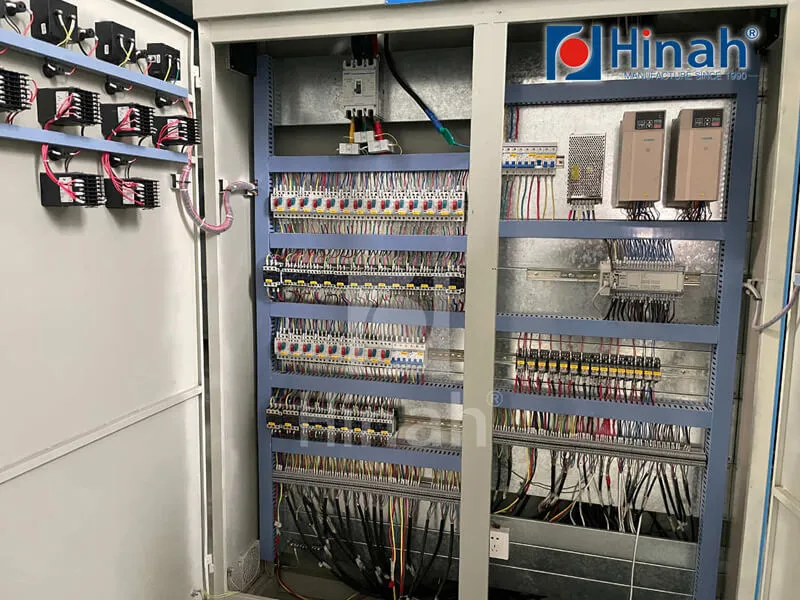
A robot alone is not a solution. Its success depends on seamless integration with high-performance peripherals and the broader production line.
The powder delivery system is paramount. Pumps, hoses, and feed hoppers must provide a perfectly consistent, pulsation-free flow of material to the robotic gun. Any fluctuation directly affects film build quality.
The spray gun itself is a key tool. Robotic systems often use specialized guns with integrated charging and advanced nozzle designs for superior pattern control. Fast-color-change mechanisms are integrated to minimize downtime between batches.
Most critically, the robot needs "eyes." Vision systems or 3D scanners are now standard. They identify the part's position and orientation on the hanger, compensating for any swing or variation, and allow the robot to adjust its path in real-time.
Modern offline programming (OLP) software has revolutionized how powder coating robots are programmed. Technicians can create and simulate spray paths on a digital twin of the part and cell within a software environment.
This allows for precise optimization of gun standoff, traverse speed, and overlap before any powder is used. Programs can be developed offline without stopping production, then uploaded to the robot.
For complex parts, the program can include adaptive logic, varying parameters for different sections. This level of control, difficult to achieve manually, maximizes quality and minimizes material use.
The upfront cost of robotic automation is a significant consideration. However, the ROI is calculated across multiple, compounding savings areas.
Material savings are immediate and substantial. Powder coating robots can achieve transfer efficiencies of 95% or higher. This reduction in overspray often pays for the system through powder cost savings alone within a defined period.
Labor reallocation is a key benefit. Operators are moved from spray booth duty to higher-value tasks like loading/unloading, inspection, and system supervision. This improves workforce utilization and reduces exposure.
Higher throughput and consistent first-pass quality reduce rework rates to near zero. This increases overall equipment effectiveness (OEE), allowing more parts to be shipped correctly the first time, every time.
At HANNA, we view robotics as a core component of a high-performance finishing system, not an add-on. Our integration process is methodical and results-driven.
We begin with a comprehensive application test in our facility. Using your actual parts, we develop and prove the optimal robotic path, gun parameters, and powder formula. This de-risks the project before installation.
We supply a fully integrated cell. This includes the robot, HANNA powder application equipment, safety fencing, and control systems engineered to work as one cohesive unit. We provide single-source accountability.
Our support extends beyond commissioning. HANNA offers extensive training for your maintenance and programming staff, along with ongoing service and spare parts support to ensure your powder coating robots deliver peak performance for their entire lifecycle.
For forward-thinking manufacturers, the question is no longer if to automate, but when and how. Powder coating robots represent a proven technological leap, delivering the consistency, efficiency, and cost control required to compete in modern manufacturing. By partnering with an experienced integrator like HANNA, you can navigate this transition smoothly and unlock a new level of performance in your finishing department.
Q1: What is the typical payback period for an investment in powder coating robots?
A1: Payback periods vary based on production volume, part complexity, and material costs. However, many of our clients at HANNA see a full return on investment within 12 to 24 months. This is achieved through direct powder savings (30-50% reduction), labor reallocation, and the virtual elimination of rework and warranty claims.
Q2: Can robots handle small batch sizes and frequent color changes?
A2: Yes, modern systems are designed for flexibility. With integrated rapid-color-change (RCC) technology, a robotic cell can switch colors in under 60 seconds. Offline programming allows new part programs to be created quickly and downloaded, making batch sizes as low as 50-100 parts economically viable for robotic coating.
Q3: Are powder coating robots safe to operate?
A3: When properly integrated with safety-rated peripherals, they are exceptionally safe. A complete cell from HANNA includes physical safety fencing, interlocked access gates, and light curtains. The system removes human operators from direct exposure to the powder spray environment, enhancing overall shop floor safety.
Q4: How do robots handle parts that swing or are inconsistently positioned on the conveyor?
A4: This is a common challenge that vision systems solve. 2D or 3D vision cameras scan the part as it enters the cell. The robot controller uses this data to adjust the pre-programmed spray path in real-time, compensating for positional variation, swing, and even part-to-part differences. This ensures consistent coating regardless of hanger positioning.
Q5: What maintenance do powder coating robots require?
A5: Robotic arms themselves are robust and require minimal routine maintenance (primarily lubrication and gearbox checks). The focus is on the application peripherals: daily cleaning of the spray gun and tips, checking powder hoses for wear, and maintaining filters in the feed system. HANNA provides detailed maintenance schedules and training to keep your uptime high.