
In the world of industrial finishing, the quality of the final product is often determined by the environment in which it is sprayed. This environment is the powder coating booth. It is the heart of the coating line, the place where transformation happens.
For manufacturers looking to upgrade their finish quality or reduce waste, investing in the right powder coating booth is the most critical decision they will make.
At HANNA, we have spent years refining the technology behind these enclosures. We understand that a powder coating booth is not just a metal box; it is a complex system of airflow, filtration, and electrostatic control designed to maximize profitability.
A powder coating booth is an enclosure designed to contain the powder application process. Its primary function is to keep the powder inside the booth and contaminants out.
Without a proper powder coating booth, overspray would drift into the factory, creating a mess and a health hazard. More importantly, a good powder coating booth allows for the recycling of overspray, which saves money.
HANNA engineers every powder coating booth to ensure that the airflow is smooth and consistent. This stability is vital because turbulent air can disrupt the spray pattern, leading to uneven finishes on your parts.
Not all production lines are the same. Therefore, the design of a powder coating booth must match the specific needs of the manufacturer.
A batch powder coating booth is ideal for low-volume production or large, heavy parts. In this setup, parts are manually wheeled in, sprayed, and then moved to an oven.
This type of powder coating booth is flexible. You can paint a bicycle frame in the morning and a large electrical cabinet in the afternoon. HANNA offers batch systems that are cost-effective and easy to install for smaller workshops.
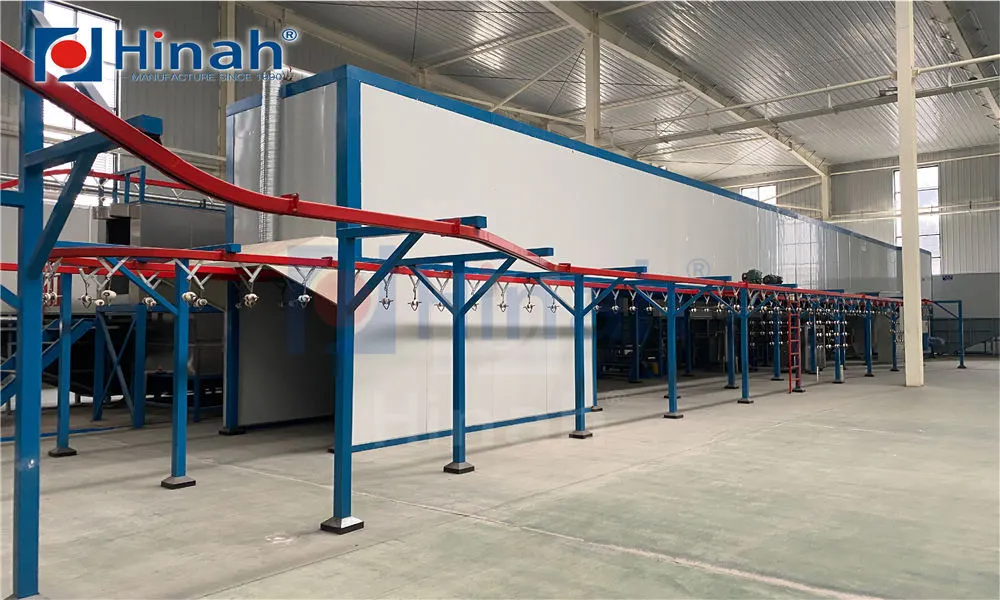
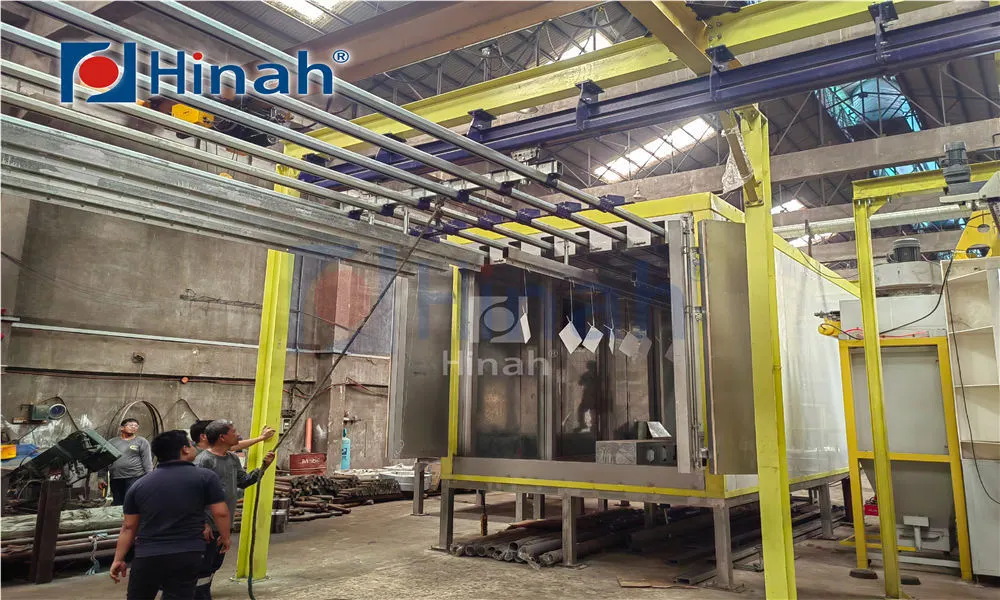
For high-volume production, an automatic powder coating booth is necessary. Here, parts hang on a continuous conveyor that travels through the enclosure.
These booths often feature openings on the sides for automatic guns (reciprocators) and slots for manual touch-up painters. A HANNA automatic powder coating booth is built for speed and efficiency, often running 24/7 in demanding industrial environments.
The material used to construct the walls of a powder coating booth impacts its performance.
Traditionally, galvanized steel was used. However, steel attracts powder due to electrostatic charges. This makes cleaning the powder coating booth difficult during color changes.
Modern designs, like those from HANNA, often utilize engineering plastics or sandwich panels. A plastic powder coating booth has dielectric properties. This means the walls reject the powder, keeping the negatively charged powder attracted to the grounded part, not the booth walls.
This technology significantly improves transfer efficiency within the powder coating booth, saving material costs.
The secret to a safe and effective powder coating booth lies in its airflow management.
Air must move past the operator and into the filtration system at a specific speed, known as "face velocity." If the air moves too slowly in the powder coating booth, powder can escape. If it moves too fast, it can blow powder off the part or disturb the electrostatic attraction.
HANNA designs every powder coating booth to maintain a consistent face velocity, usually between 100 to 120 FPM (feet per minute). This ensures containment without compromising finish quality.
One of the biggest advantages of powder over liquid paint is recoverability. A high-quality powder coating booth allows you to reclaim overspray.
There are two main types of recovery systems used in a powder coating booth:
In a cartridge-based powder coating booth, the air is drawn directly through filters. The powder is trapped on the filter surface. Periodically, a pulse of compressed air blows the powder off the filters into a collection bin.
This type of powder coating booth is highly efficient but is best suited for companies that do not change colors often. If you spray only black, a cartridge powder coating booth is perfect.
For companies that change colors multiple times a day, a cyclone powder coating booth is the industry standard.
The cyclone separates the powder from the air using centrifugal force. The reusable powder falls to the bottom to be sieved and returned to the hopper. Only the finest dust goes to the final filter.
HANNA specializes in cyclone powder coating booth systems that allow for color changes in as little as 15 minutes.
In the modern market, "Just-in-Time" manufacturing is key. You cannot afford to shut down your line for three hours to clean the powder coating booth.
HANNA has developed the "Fast Color Change" powder coating booth. These systems utilize non-stick materials, automated air knives, and walk-in designs that make cleaning rapid.
By reducing downtime in the powder coating booth, you increase the total number of parts coated per shift. This directly improves your bottom line.
Powder coating involves fine dust, which can be combustible. Therefore, a powder coating booth must be designed with strict safety standards.
Every HANNA powder coating booth is equipped with fire detection sensors. If a spark is detected, the system shuts down the spray guns and the ventilation immediately.
Furthermore, the powder coating booth must have adequate venting to prevent the concentration of powder from reaching the Lower Explosive Limit (LEL). Our engineers calculate the air volume requirements for every specific powder coating booth we sell to ensure compliance with international safety codes.
You cannot paint what you cannot see. Lighting in a powder coating booth is often overlooked, but it is crucial.
A dark powder coating booth leads to missed corners and light coverage. HANNA integrates high-lux, explosion-proof LED lighting into the ceiling and walls of the powder coating booth.
This provides the operator with clear visibility, reducing the need for rework. A well-lit powder coating booth is a productive workspace.
To keep your powder coating booth running at peak performance, regular maintenance is required.
Filters should be checked daily. A clogged filter increases pressure in the powder coating booth, reducing airflow. This can cause powder to drift out of the openings.
The hopper and sieves associated with the powder coating booth must be kept free of debris. Small clumps of cured powder can block the venture pumps.
HANNA provides detailed maintenance schedules with every powder coating booth installation, ensuring your team knows exactly what to check and when.
Even the best powder coating booth can face issues if not managed correctly.
Drifting Powder: If powder is escaping the powder coating booth, check the fan belts and filters. Often, it is a simple lack of suction.
Cross Contamination: If you see specks of a previous color on a new part, the powder coating booth was not cleaned properly. This highlights the importance of choosing a HANNA booth designed for easy cleaning.
Poor Transfer Efficiency: If the powder is going into the filters and not on the parts, check the grounding. A powder coating booth relies on a good earth ground for the physics to work.
When buying a powder coating booth, do not just look at the sticker price. Consider the operational costs.
A cheap powder coating booth might have poor airflow design, requiring larger motors that use more electricity. It might have poor recovery efficiency, wasting tons of powder a year.
A HANNA powder coating booth is designed for energy efficiency. We use variable frequency drives (VFDs) on our fans to only use the power necessary. The superior recovery rate of a HANNA powder coating booth pays for the equipment over time through material savings.
Sometimes, a standard catalog powder coating booth will not fit your factory or your products.
You might be coating 20-foot long aluminum profiles, or tiny medical components. HANNA offers custom engineering. We can build a powder coating booth that is tall, wide, or shaped to fit around existing building columns.
Customization ensures that the powder coating booth serves your process, rather than your process suffering because of the equipment limitations.
The modern powder coating booth is rarely a standalone island. It talks to the rest of the factory.
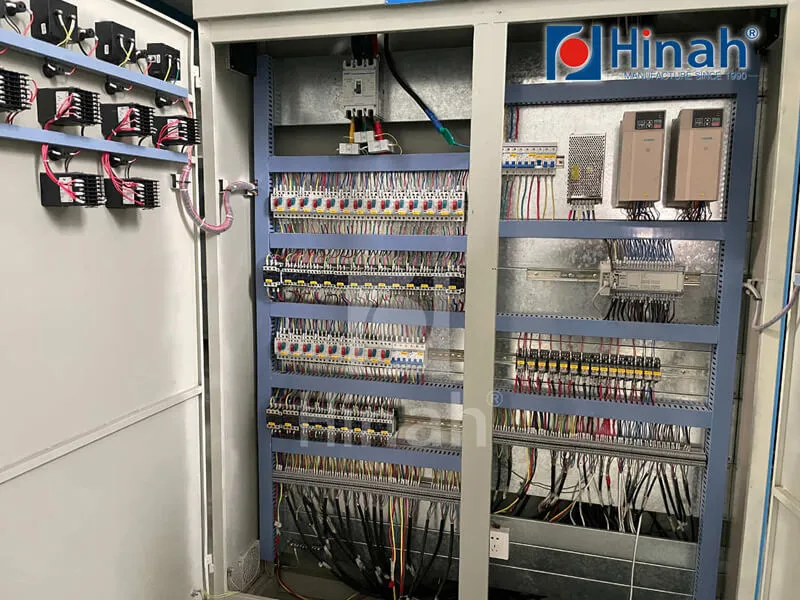
HANNA booths can be integrated with PLCs that control the reciprocators and the conveyor. When the conveyor stops, the powder coating booth fans can ramp down to save energy.
Sensors at the entrance of the powder coating booth detect the part size and adjust the gun movement automatically. This level of integration is what separates a basic booth from a smart manufacturing solution.
In the competitive market of finishing equipment, HANNA stands out. We focus specifically on the nuances of the powder coating booth.
We do not just weld metal sheets together. We model airflow using computer simulations to guarantee that every HANNA powder coating booth performs as promised.
Our global presence means that spare parts for your powder coating booth are never far away. Support is essential when your production line is down.
The future of the powder coating booth is digital. We are seeing the rise of "Industry 4.0" in finishing.
Soon, your powder coating booth will predict when filters need changing before they clog. It will monitor humidity and temperature in real-time and adjust settings to compensate.
HANNA is at the forefront of this R&D. We are building the powder coating booth of tomorrow, today.
The powder coating booth is the vessel in which value is added to your product. It determines the safety of your workers, the efficiency of your material usage, and the beauty of your final product.
Settling for a sub-par powder coating booth creates a bottleneck that limits your company's potential.
By choosing a HANNA powder coating booth, you are investing in reliability, efficiency, and world-class engineering. Whether you need a small batch unit or a massive automated cyclone system, HANNA has the expertise to deliver.
Upgrade your production line today. Choose a powder coating booth that works as hard as you do.
Q1: How often should I change the filters in my powder coating booth?
A1: This depends on production volume. In a high-production powder coating booth, cartridge filters usually last 1 to 2 years. However, if you notice the pressure gauge differential rising significantly or airflow dropping, it is time to replace them. Regular pulse-cleaning extends their life.
Q2: What is the difference between a stainless steel and a plastic powder coating booth?
A2: A stainless steel powder coating booth is durable and cheaper but attracts powder, making it harder to clean. A plastic (or sandwich panel) powder coating booth resists powder attraction, allowing for much faster cleaning and higher transfer efficiency onto the parts.
Q3: Do I need a fire suppression system in my powder coating booth?
A3: Yes. Due to the combustibility of powder dust, most local fire codes and insurance companies require an automatic fire suppression system installed within the powder coating booth. HANNA systems come pre-engineered to accept these safety devices.
Q4: Can I use the same powder coating booth for different colors?
A4: Yes, but you must clean it thoroughly between colors to avoid contamination. If you change colors frequently (e.g., 5 times a day), a cyclone recovery powder coating booth is highly recommended as it separates the powder from the airflow, making the cleaning process much faster than a standard filter booth.
Q5: How much air (CFM) does a powder coating booth need?
A5: The CFM (Cubic Feet per Minute) is calculated based on the size of the booth openings. The standard requirement is to maintain a face velocity of at least 100 FPM across all openings to ensure powder containment. HANNA engineers calculate the exact CFM needed for your specific powder coating booth dimensions.