When manufacturers move from manual spraying to automated finishing, the painting robot becomes the centerpiece of quality assurance. Unlike human operators, robotic applicators deliver repeatable film thickness, predictable edge coverage, and controlled overlap patterns. However, selecting and programming a painting robot involves far more than choosing a six-axis arm. The true value emerges from system integration — coordinating conveyor tracking, flow rate modulation, and environmental sensors. This article examines technical specifications, application patterns, and performance validation methods for robotic painting cells, providing data-driven guidance for operations targeting first-pass yield above 95%.
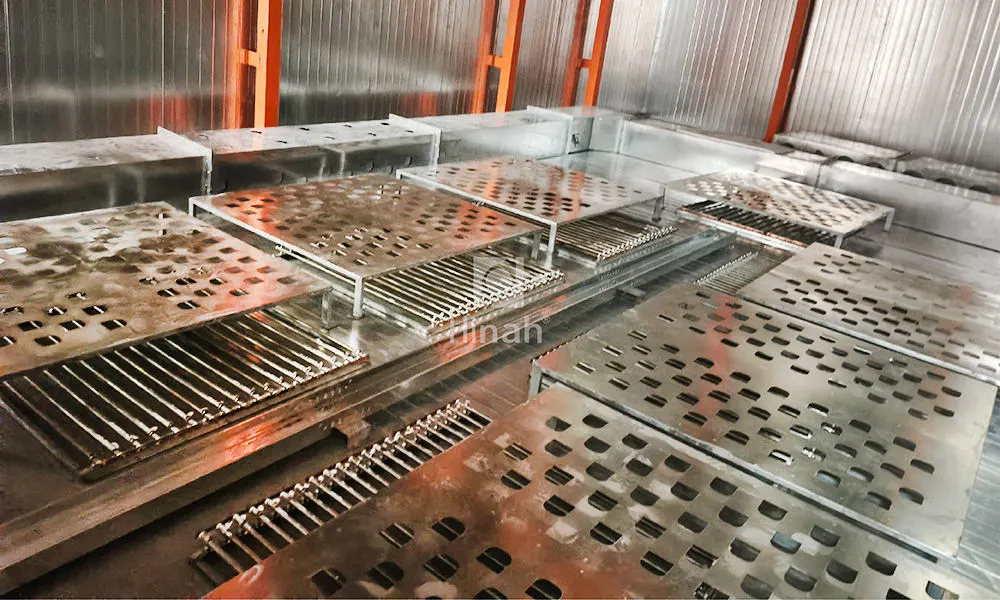
A complete robotic finishing station includes five interdependent subsystems: the manipulator (4 to 7 axes), fluid delivery system (pumps, regulators, valves), applicator (air spray, airless, or electrostatic rotary bell), part positioning or tracking, and safety enclosure. The painting robot arm must achieve IP67 protection against solvent and powder ingress. Payload capacity ranges from 5 kg for small parts to 30 kg for dual-bell systems. Cycle time calculations depend on TCP (tool center point) velocity, typically 600–1,500 mm/s for reciprocating paths. Advanced controllers incorporate real-time feedback from thickness sensors (laser or ultrasonic), adjusting flow within 50 ms to compensate for part geometry variations. For high-volume lines, HANNA integrates vision-guided painting robot cells that automatically read part barcodes and select pre-validated motion programs, reducing changeover errors by 90%.
Efficiency of a painting robot depends on three programming layers:
Trajectory generation: Using CAD data to create offset paths that maintain standoff distance (150–250 mm for bells, 200–300 mm for spray guns). Corner rounding (Bézier smoothing) reduces acceleration spikes, preventing overspray patterns.
Velocity profiling: Constant TCP speed is ideal, but geometry forces deceleration at sharp edges. Advanced robots use "look-ahead" algorithms to pre-calculate velocity changes, keeping flow-to-speed ratio within ±3%.
Trigger logic: Proximity sensors or encoder feedback triggers spray on/off with 10–20 ms latency. Missed triggers cause bare spots; delayed shut-off creates heavy edges. Optimal settings require 50–100 ms lead time for bell turbine spin-up.
Field studies on automotive primer lines show that optimized path planning reduces material consumption by 14% compared to manually taught points. For a painting robot coating 300,000 parts annually, this translates to savings of $38,000 in paint alone. HANNA provides offline programming (OLP) software that simulates trajectories and predicts film build before any physical setup, compressing commissioning time from weeks to days.
Requirements: film thickness tolerance ±5 µm, no runs or sags on vertical surfaces. Painting robot cells use electrostatic rotary bells (40,000–60,000 rpm) with shaping air to control pattern width (250–450 mm). Conveyor tracking synchronized to 0.2 mm accuracy ensures consistent overlap. A six-robot station (primer, basecoat, clearcoat) achieves line speeds up to 8 m/min.
Large parts with deep cavities demand long-reach arms (2,500–3,200 mm horizontal reach). Painting robots in this sector often mount on 7th-axis linear rails to extend workspace. Air-assisted airless guns provide higher transfer efficiency for high-viscosity primers (up to 20,000 cP).
Strict compliance with NADCAP standards requires full traceability of each spray pass. Painting robots here incorporate flow meters with ±0.5% accuracy and record all parameters to a secure database. Explosion-proof designs (ATEX Zone 2) are mandatory.
For each vertical, HANNA supplies pre-engineered painting robot workcells with validated process recipes, reducing startup risk for integrators and end users.
Even with a high-specification painting robot, three defects frequently occur:
Orange peel (excess texture): Caused by atomizer pressure too low or bell speed too high. Remedy: increase shaping air by 0.2 bar increments while reducing bell speed by 5,000 rpm. Measure surface roughness (Ra) — acceptable range is 0.2–0.5 µm for topcoats.
Edge pull-back (bare corners): Occurs when electrostatic wrap is insufficient. Increase voltage by 10 kV (for liquid electrostatic) or move robot path 30 mm closer to edge. For non-electrostatic, add a 50 ms dwell at edges.
Mottled appearance (metallics): Metallic flake orientation disrupted by excessive turbulence. Reduce booth air velocity from 0.5 m/s to 0.3 m/s and lower atomizing pressure by 15%.
Data from 40 installations show that implementing automated defect detection (camera-based inline inspection) reduces rework by 62% when paired with closed-loop feedback to the painting robot controller.
Transitioning from manual to robotic finishing requires a financial model based on four direct savings:
Material savings: Manual operators typically achieve 45–55% transfer efficiency. A well-programmed painting robot with electrostatic bells reaches 75–85% TE. For a line consuming $250,000 of paint annually, material savings of 30% = $75,000 per year.
Labor reduction: One robot replaces two to three manual painters per shift, including associated benefits and booth cleaning time. Annual labor saving: $120,000–180,000 (two-shift operation).
Rework reduction: Manual defect rates (orange peel, runs, holidays) average 8–12%. Robotic application with inline inspection reduces rework to 3–5%. Saving: $15,000–25,000 per year in sanding, respray, and lost throughput.
Throughput increase: Robots maintain consistent speed without fatigue, enabling line speed increases of 15–25%. Additional output value depends on margin per part, but typical gain: $40,000–60,000 annually.
Total annual benefit: $250,000–340,000. A fully integrated painting robot cell with safety fencing, feed system, and programming costs $220,000–380,000. Payback period: 9–15 months. HANNA offers ROI calculators that incorporate local labor rates and material costs to generate site-specific projections.
Industry 4.0 transforms the painting robot from an isolated actuator into a predictive maintenance asset. Key telemetry includes:
Joint temperature and vibration: Accelerometers on each axis detect bearing wear 200–300 hours before failure. Threshold: vibration velocity >1.5 mm/s triggers inspection.
Flow rate deviation: Real-time comparison between demanded and actual flow. Sustained deviation >3% indicates pump seal wear or viscosity drift.
Air consumption: Atomizing and shaping air pressures logged per cycle. Gradual increase (without program change) suggests internal air leaks or regulator failure.
Cycle time trend: Any increase beyond programmed baseline (e.g., from 45 to 48 seconds) signals mechanical drag or path corruption from worn gears.
Cloud-based analytics from HANNA dashboard these parameters and send alerts to maintenance teams, reducing unplanned downtime by 55% across monitored installations. One automotive supplier reported saving $87,000 in avoided production loss during a single quarter after implementing predictive alerts on their painting robot fleet.
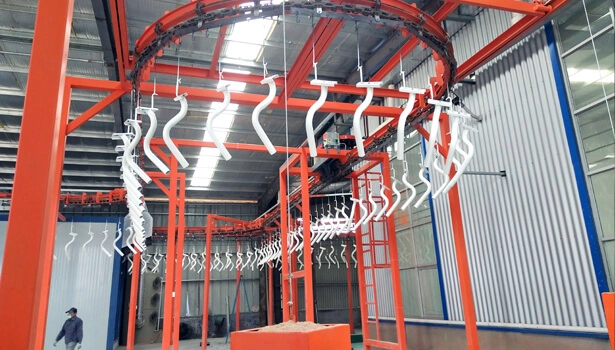
Painting robots operate in hazardous environments where solvent vapors or combustible dusts can accumulate. Compliance requirements include:
ATEX 137 (EU) / NFPA 33 (US): Robots must be certified for Zone 1 (gas) or Zone 21 (dust) when used inside spray booths. Purged and pressurized enclosures are mandatory for non-explosion-proof models.
ISO 10218-1 & 10218-2: Safety-rated monitored stop, speed limiting, and separate protective stop circuits. Light curtains or laser scanners must detect personnel entry and initiate a controlled halt within 150 ms.
ANSI/RIA R15.06: Requires risk assessment for each robot cell, including pinch points, stored energy (pneumatic/hydraulic), and electrostatic discharge risks.
Ignoring these standards leads to fines up to $70,000 per violation (OSHA) plus liability exposure. HANNA provides turnkey cells that come with CE or UL certification and full documentation for local authority approvals.
Q1: What is the typical programming time for a new painting robot
path on a complex part?
A1: Manual teach-pendant
programming for a part with 12 surfaces and 3 coat layers requires 24–40 hours
for an experienced technician. Offline programming (OLP) using CAD reduces this
to 6–10 hours plus 4 hours of touch-up on the physical robot. For high-mix
low-volume operations, painting robot manufacturers now offer adaptive path
planning using 3D vision — the robot scans the part and generates a path in
under 10 minutes without any manual teaching.
Q2: How do I select between a 6-axis and a 7-axis painting
robot?
A2: A 6-axis robot is sufficient for parts
that can be presented within a fixed workspace (diameter ≤1.5 m). A 7th axis
(linear rail) extends reach to 3–5 m and allows the robot to follow a moving
conveyor without a separate tracking system. Cost difference: 7-axis
configuration adds $35,000–$50,000. Choose 7-axis if you have continuous
conveyor speeds above 4 m/min or part length exceeding 2.5 m. For batch
processing on stationary fixtures, a 6-axis painting robot is more cost-effective.
Q3: What transfer efficiency can I expect from an electrostatic
painting robot versus air spray?
A3: A
non-electrostatic air spray gun operated by robot achieves 55–65% TE. Adding
electrostatic charging (60–90 kV) raises TE to 75–85% for flat parts and 65–75%
for complex geometries. Rotary bell applicators on a painting robot reach 85–92% TE but are limited to
lower viscosity coatings (<2,000 cP). For high-solids primers (>4,000 cP),
use electrostatic air-assisted airless guns (TE 70–78%). Always verify TE via
gravimetric test (ISO 8130-10) on your specific part shape.
Q4: How frequently should I perform preventive maintenance on the
robot's wrist and bell applicator?
A4: Based on
4,000 operating hours per year (two shifts): Change wrist gear grease every
8,000 hours or annually. Inspect bell turbine bearings every 1,000 hours —
replace if axial play exceeds 0.05 mm. Clean bell cup and shaping air ring after
each color change or every 80 hours of operation. For high-solvent coatings,
check wrist seal integrity every 500 hours (leak test with isopropyl alcohol). A
neglected painting robot wrist failure costs $8,000–15,000 in
parts plus two days of downtime — scheduled maintenance avoids this.
Q5: Can a painting robot handle multiple colors without long cleaning
downtime?
A5: Yes, using a color change valve block
mounted near the robot base. Flush sequence: solvent purge (15 seconds), air
blow (10 seconds), then next color fill (8 seconds). Total changeover time:
35–50 seconds. For high-volume automotive lines, dual-arm painting robots with
separate fluid paths for basecoat and clearcoat eliminate inter-coat flushing.
HANNA supplies quick-change fluid systems that reduce
color-to-color cleaning solvent consumption by 70% compared to traditional
manual flushing methods.