
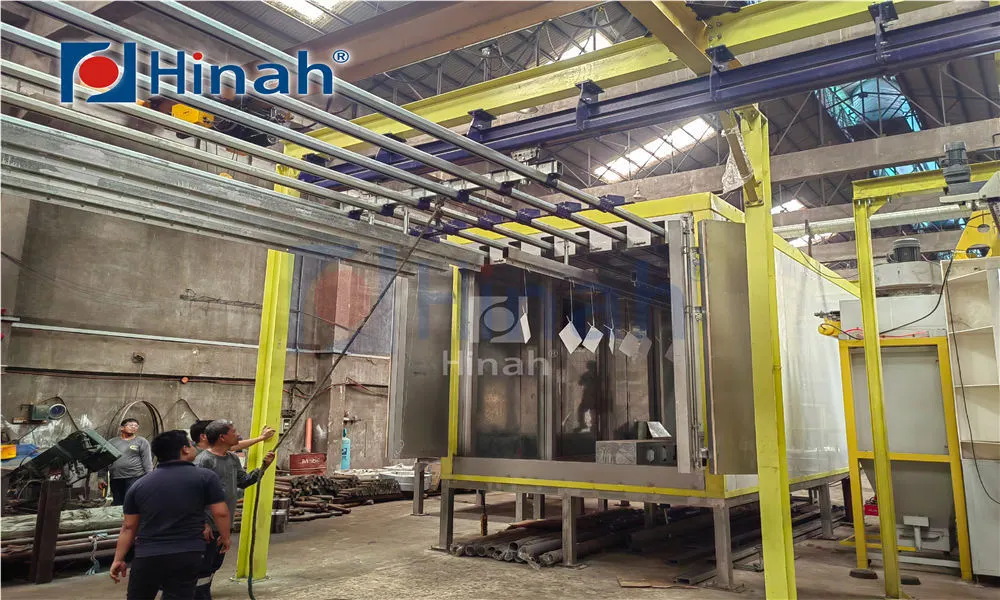
In high-volume industrial finishing, the transition from manual booths to a fully integrated automatic powder coating line represents a fundamental shift in operational economics. For coaters serving automotive, architectural, and appliance sectors, the margin for error is measured in microns, and profitability hinges on first-pass yield rates. Having overseen over 200 line integrations across North America and Europe, I’ve observed that the distinction between a line that merely functions and one that delivers 99.5% transfer efficiency lies not in the individual components, but in their closed-loop synchronization.
This analysis dissects the critical subsystems—from material handling to curing kinematics—that define a world-class automatic powder coating line. We will examine specific engineering parameters, quantify the cost implications of process drift, and outline how HANNA integrates Industry 4.0 principles to transform coating lines into profit centers.
While the elimination of manual labor variance is often cited as the primary driver for automation, the actual ROI of an automatic powder coating line is rooted in material savings and defect elimination. Industry data indicates that manual coating operations average a 40-55% transfer efficiency. In contrast, a modern automated system with optimized cloud chamber technology and advanced powder recovery consistently achieves 85-95% efficiency.
For a facility processing 1,200 tons of powder annually, an 18% reduction in material waste translates to approximately $280,000 in direct savings per year. However, the true value proposition extends to consistency. In high-mix, low-volume (HMLV) environments, automated systems utilizing real-time color change management reduce downtime from 45 minutes per color change to under 8 minutes, drastically improving overall equipment effectiveness (OEE).
A fragmented approach—purchasing a washer from one vendor, a booth from another, and a conveyor from a third—often results in communication latency. A robust automatic powder coating line functions as a unified mechanical and electronic ecosystem.
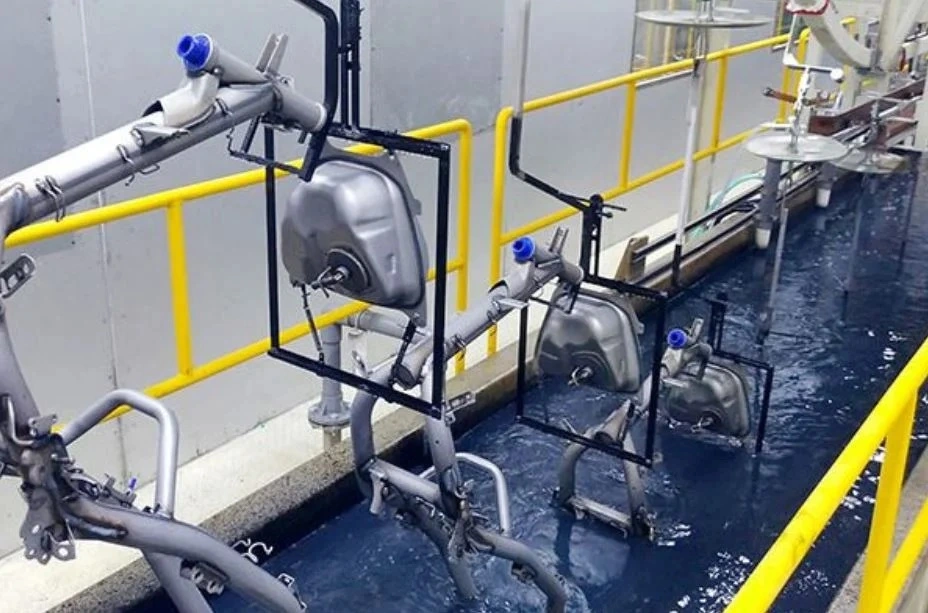
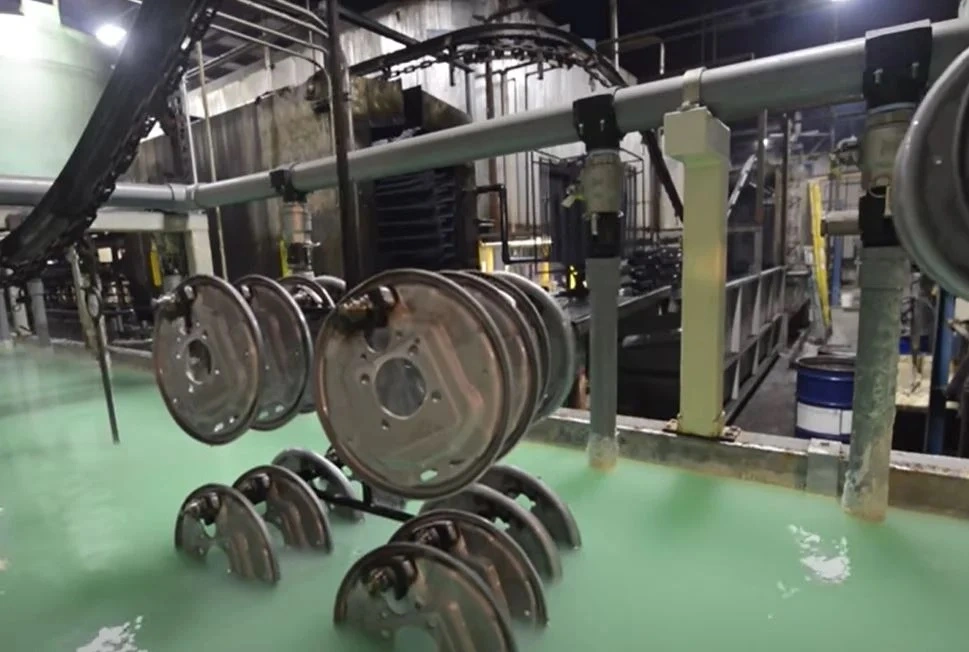
Adhesion failures originate in the pre-treatment stage. Modern lines employ multi-stage spray washers with precise chemical dosing controls. Key parameters include:
Zirconium vs. Iron Phosphate: Zirconium-based nanotechnology reduces water consumption by 30% and operates at ambient temperatures, lowering energy bills for facilities with high throughput.
Water Quality Monitoring: Conductivity levels must remain below 200 µS/cm in the final rinse. Automated chemical replenishment systems prevent scale buildup that would otherwise manifest as pinholes in the cured film.
The application zone is where the automatic powder coating line differentiates itself. Conventional systems use fixed gun positions, leading to the Faraday cage effect on complex geometries. High-performance architectures utilize:
Reciprocators with Adaptive Stroke Control: Servo-driven vertical reciprocators that adjust stroke length and speed based on part dimensions, ensuring uniform film build (typically 60-80 microns) on edges and recesses.
Multicolor Booths with Cyclone Recovery: Compact Integration (CI) booths equipped with high-efficiency cyclones reclaim overspray with less than 1% cross-contamination, critical for facilities running multiple color SKUs daily.
Undercuring compromises impact resistance (ASTM D2794), while over-baking leads to yellowing and brittleness. An advanced line integrates infrared (IR) and convection zones. For high-density substrates like cast iron, IR panels initiate flow-out within 90 seconds, while convection ensures core temperature uniformity. Real-time data loggers must track part temperature, not just air temperature, to guarantee full cross-linking.
Different sectors impose unique stressors on the automatic powder coating line. Here are the specific engineering responses required.
Pain Point: Conveyor sagging and inconsistent coating on vertical surfaces.
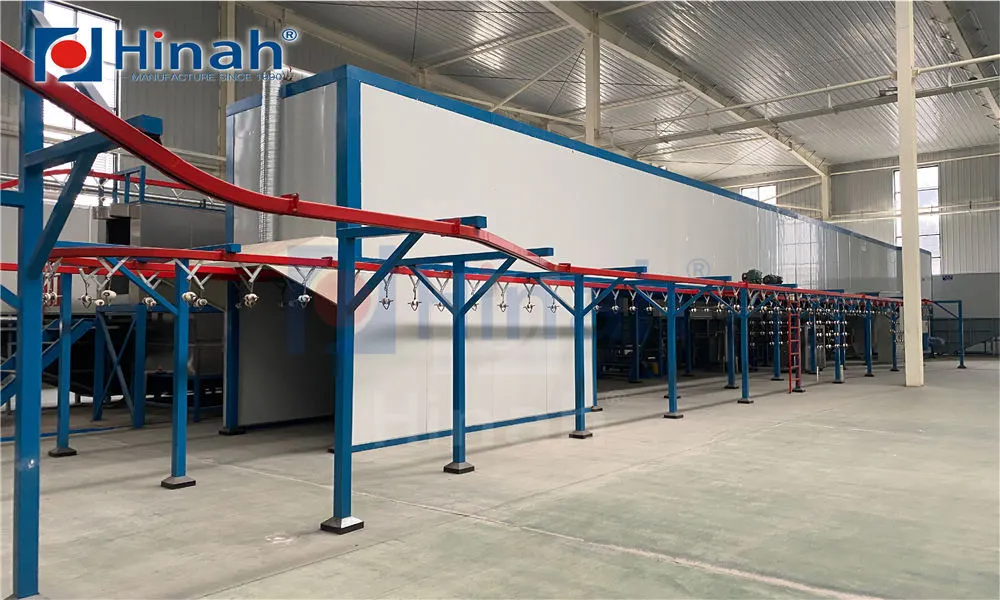
Solution: Overhead monorail conveyors with load wheels spaced at 6-foot intervals to maintain rigidity. Coupled with oscillating disk applicators that provide 270-degree wrap-around coverage, these lines achieve 1.5 mil thickness variance of less than 5% across 20-foot lengths.
Pain Point: Film uniformity on sharp edges (corrosion initiation points) and throughput bottlenecks.
Solution: Integration of powder management centers that continuously condition the powder, maintaining fluidization density and eliminating "rat-holing" in hoppers. Edge coverage is achieved via dual-voltage guns (operating at 70-100 kV for wrap, reduced to 40-60 kV for detail) within a closed-loop control system.
Pain Point: Contamination ingress and difficulty coating heavy, irregular parts.
Solution: Walk-in booths with floor-level recovery systems and heavy-duty reciprocators. These lines prioritize durability, utilizing impact-resistant epoxy-polyester hybrids cured for extended dwell times to ensure chipping resistance.
The largest operational cost for any automatic powder coating line is unscheduled downtime, which can exceed $5,000 per hour in the automotive supply chain. Predictive maintenance protocols are now standard in best-in-class operations.
Key KPIs to monitor:
Gun Wear: Monitoring the current draw (amperage) of each gun. A 15% increase in amperage without a change in output voltage indicates electrode contamination or cable degradation.
Air Flow Integrity: Low-pressure alarms in the powder feed center that detect leaks before they result in surging (pulsating spray patterns).
Burner Modulation: In curing ovens, tracking the frequency of burner cycles. Frequent cycling often indicates poor insulation or excessive airflow, wasting 10-15% of energy costs.
For organizations seeking to modernize their finishing department, partnering with a single-source integrator ensures that these subsystems are optimized for cohesion. HANNA specializes in retrofitting existing lines with Industry 4.0 sensor suites, enabling facility managers to transition from reactive to predictive maintenance schedules without the capital expenditure of a full greenfield installation.
As sustainability mandates tighten globally, the automatic powder coating line is evolving into a zero-emission asset. The next generation of lines leverages digital twin technology. Before a single bolt is turned, engineers simulate powder trajectories, airflow dynamics, and thermal gradients in a virtual environment.
This simulation capability reduces physical commissioning time by up to 40% and ensures that the actual line achieves:
Powder Savings: 5-8% additional reduction through optimized air-flow balancing.
Carbon Reduction: Lower cure temperatures (down to 160°C for low-cure powders) facilitated by improved oven insulation and IR zones.
Material Circularity: Closed-loop filtration systems that capture 99.9% of particulate matter, ensuring compliance with EPA and EU VOC regulations.
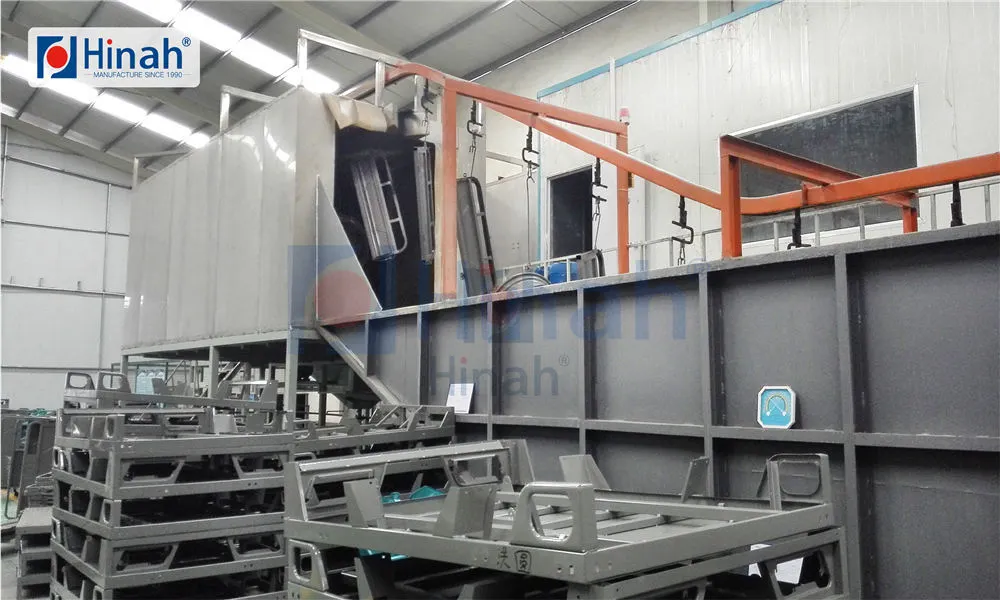
The decision to invest in an automatic powder coating line should be viewed not as a replacement for manual labor, but as a strategic tool for market differentiation. With tightening tolerances from OEMs and increasing pressure to reduce lead times, the ability to guarantee first-pass yield rates above 96% becomes a decisive competitive factor. By prioritizing system integration, real-time monitoring, and subsystem optimization, coaters can achieve a payback period of under 24 months while positioning their operations for the future of sustainable manufacturing.
For detailed technical specifications or to conduct a feasibility study for your specific product mix, contact the engineering team at HANNA. Their approach focuses on customized integration, ensuring your new line aligns perfectly with your production goals.
Q1: What is the typical ROI period for replacing a manual batch
system with an automatic powder coating line?
A1: Based on current market analysis of facilities running 2+ shifts, the ROI
typically ranges between 18 and 24 months. The primary drivers are labor cost
reduction (typically 3-4 operators eliminated per shift), material savings from
85%+ transfer efficiency, and reduced rework costs. Facilities processing
high-value coatings (e.g., architectural finishes or automotive clear coats)
often see accelerated ROI due to lower defect rates.
Q2: How does an automatic powder coating line handle complex
geometries or parts with deep recesses (Faraday cage
areas)?
A2: Modern automated lines utilize several
technologies to overcome the Faraday cage effect. These include tribo-electric
charging systems (which use friction rather than high voltage), oscillating disc
applicators for wrap-around coverage, and multi-axis reciprocators that change
gun angles dynamically. Closed-loop feedback systems also adjust KV and
micro-amps in real-time based on the part profile to ensure penetration into
recessed areas.
Q3: What are the key maintenance requirements specific to an
automatic powder coating line?
A3: Critical
maintenance falls into three categories: (1) Pneumatic hygiene: Regularly draining air filters and checking for moisture contamination, as
moisture causes powder clumping. (2) Gun maintenance: Daily
cleaning of electrode tips and weekly inspection of venturi blocks for wear. (3)
Conveyor lubrication: Trolley wheels require high-temperature
grease to prevent seizure in the oven zone, which can cause line stoppage.
Q4: Can an automatic powder coating line be integrated into an
existing facility with limited floor space?
A4: Yes. Compact integration (CI) designs are increasingly popular for
space-constrained facilities. These systems consolidate the powder booth,
cyclone recovery unit, and sieving station into a single footprint.
Additionally, serpentine or vertical conveyor layouts allow for extended cooling
and curing times without expanding the building’s length. Custom integrators
like HANNA specialize in
designing layouts that optimize existing square footage.
Q5: How does the choice of conveyor system impact the overall
efficiency of the line?
A5: The conveyor acts as
the central nervous system. A mismatch between conveyor speed and oven dwell
time creates bottlenecks. For heavy parts, power-and-free conveyors allow for
accumulation and buffer zones, enabling the line to continue running during
manual unloading/loading. For high-speed, consistent parts, a continuous
overhead monorail is more efficient. The selection directly impacts
throughput—typically measured in racks per hour—and must be calculated based on
the largest part’s thermal mass and coating requirements.