The final properties of a composite part—its strength, durability, and dimensional stability—are fundamentally determined in the curing stage. A composite curing oven is not merely a heated box; it is a precision instrument that drives critical chemical reactions. Selecting the right one is a major capital decision that impacts your production throughput, part quality, and long-term operational costs. Whether you're working with carbon fiber prepregs, fiberglass laminates, or bonded assemblies, the oven is where your material specifications are either fully realized or compromised. This guide walks through the essential engineering and operational factors you must evaluate to make an informed choice for your application.
Your production volume and part size dictate the basic configuration. There are two primary designs, each with distinct advantages.
Batch ovens, also known as walk-in or cabinet ovens, are versatile workhorses. They are ideal for low-to-medium volume production, large or complex single parts, and research and development work. You load the oven, initiate the cure cycle, and unload once complete.
Continuous ovens, often designed as conveyorized tunnel ovens, are built for high-volume throughput. Parts on a conveyor move through different temperature zones at a controlled speed. This setup is perfect for consistent, repeatable curing of similar-sized components, providing a steady flow of finished parts.
This is the single most important performance metric for any composite curing oven. Inconsistent heat distribution leads to uneven cure, residual stresses, warpage, and ultimately, part failure.
Achieving true uniformity requires more than just heaters and a fan. It demands a carefully engineered airflow pattern. Top-tier manufacturers like HANNA use computational fluid dynamics (CFD) to model and design their airflow systems.
Look for certification. Reputable suppliers provide a temperature uniformity survey map (often to ±3°C or better across the entire work zone) as standard documentation. Never assume uniformity; always demand proof of performance data.
How air moves within the composite curing oven chamber is a key design choice that affects both uniformity and handling.
Horizontal airflow (HAF) systems are common and effective for many applications. Air is moved laterally across the workspace by fans mounted on the side or rear. This design is excellent for racked parts or shelves, providing consistent front-to-back temperature profiles.
Vertical airflow (VAF) systems, where air is forced down from the top and returned through the floor plenum, offer distinct advantages for composites. This "downflow" pattern minimizes particle entrapment on sensitive surfaces and can provide superior uniformity for large, flat panels. It's a feature often specified in high-performance curing applications.
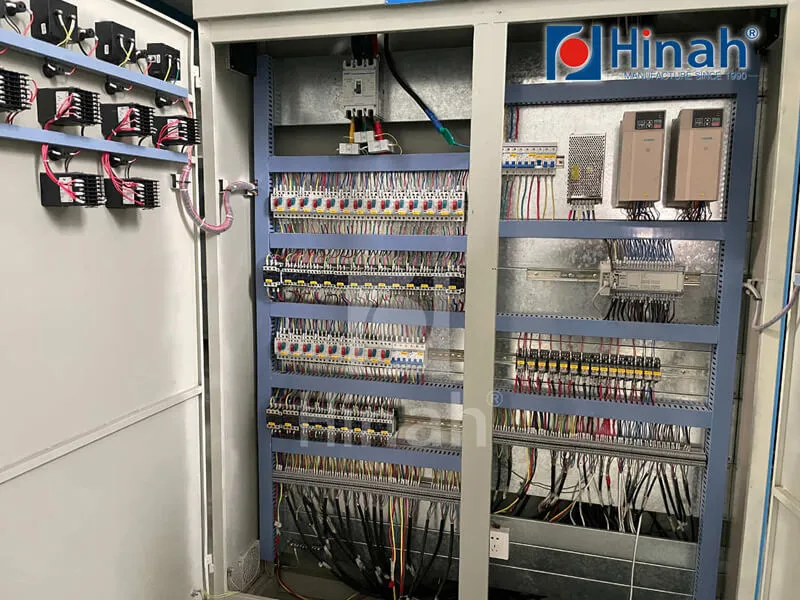
Modern composites require precise, repeatable thermal profiles. A simple on/off thermostat is wholly inadequate. The control system is the brain of the composite curing oven.
You need a programmable logic controller (PLC) with a user-friendly touchscreen interface. It should allow you to create, store, and execute multi-step ramp-and-soak cure cycles with ease. These profiles control the rate of temperature increase, hold times, and cool-down phases precisely.
Data logging is a critical feature for quality assurance and traceability. The system should record the actual temperature profile of each cure cycle, providing a verifiable record that the specified parameters were met. HANNA ovens integrate these logging capabilities directly into their control platforms.
Industrial ovens operate at high temperatures and must be designed with inherent safety. Look for robust over-temperature protection with independent, redundant safety thermostats that cut power if primary controls fail.
Properly rated door interlocks that shut off heaters when the door is open are a basic necessity. Interior lighting, viewports, and well-insulated exterior surfaces protect operators.
Energy efficiency is a major operational cost driver. High-density insulation in walls, doors, and ceilings is essential. Consider heat recovery systems on exhaust air streams. Efficient burner systems (for gas) or properly sized electric heating elements managed by advanced controllers can significantly reduce energy consumption over the oven's lifespan.
Off-the-shelf ovens rarely meet all specialized needs. A composite curing oven may require specific modifications.
For vacuum-bagged parts, you may need internal shelving or structure to support vacuum hoses and lines. Some processes require inert atmospheres like nitrogen to prevent oxidation; this demands a tightly sealed chamber and gas injection systems.
Very large aerospace or automotive components require custom-sized chambers. Leading manufacturers like HANNA specialize in engineering these tailored solutions, ensuring the oven geometry and performance match the exact application.
Investing in a composite curing oven is a strategic decision that directly influences your product quality and manufacturing capability. The right choice balances precise temperature control, reliable and safe operation, and long-term energy efficiency. It requires a detailed analysis of your materials, production volume, and part geometry.
By partnering with an experienced manufacturer that understands the science of curing—one that provides verified performance data, robust controls, and tailored engineering support—you secure a foundational asset for your composites operation. Companies like HANNA bring this essential combination of precision engineering and application expertise to the table, ensuring your oven is a reliable partner in production for years to come.
Q1: What temperature range is typically required for a composite curing oven?
A1: The range varies widely by resin system. Standard epoxy systems often cure between 120°C and 180°C (250°F - 350°F). High-temperature epoxies and polyimides can require 200°C to 370°C (400°F - 700°F) or more. It's crucial to specify an oven with a maximum temperature that exceeds your current and foreseeable future needs.
Q2: How long does it take for a large batch oven to reach the required curing temperature?
A2: Heat-up time depends on oven chamber size, insulation quality, heating power, and the starting temperature. A well-insulated industrial oven from a brand like HANNA might take 45-90 minutes to reach a stable 180°C from room temperature. Ask suppliers for heat-up rate data specific to the model you're considering.
Q3: What are the main pros and cons of electric vs. gas-fired curing ovens?
A3: Electric ovens offer cleaner operation, precise control, and are often simpler to install where gas lines are unavailable. Gas-fired ovens generally have much lower operating energy costs in regions with cheap natural gas and can offer faster heat-up times. The choice often comes down to local utility costs and facility infrastructure.
Q4: Why is airflow pattern so critical in a composite curing oven?
A4: Composites are sensitive to exothermic reactions and require even heat application to cure uniformly. Poor airflow creates hot and cold spots. This leads to uneven cross-linking in the resin, causing internal stresses, reduced mechanical properties, warping, and potential delamination. Proper airflow design ensures every part of the component sees the same temperature.
Q5: Can I retrofit my existing oven with advanced data logging or new controls?
A5: Often, yes. Many oven manufacturers, including HANNA, offer upgrade services for existing equipment. This can involve installing a new PLC control touchscreen, adding data logging software, or retrofitting more efficient heating elements. It's a cost-effective way to extend the life and capabilities of a reliable oven without a full replacement.